Tag Archives: collaboration

Building Model Client-Designer Relationships

You don’t need to be a designer to benefit from the best practices espoused in this magnificent new book. A must-have for designers, those in design management and anyone who works with designers on integrated teams.

What does a book on design strategy have to do with BIM and integrated design?

It turns out - a great deal.

For it turns out that today designers of all stripes emphasize co-creation, communication, mutual benefit, respect and trust in building strong team relationships.

These qualities are no longer the sole province of those participating in Integrated Project Delivery.

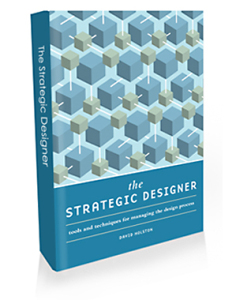
Based on over 100 interviews with designers, researchers and educators, The_Strategic_Designer by David Holston provides an overview of the design process and designer’s best practices.

The Strategic Designer: Tools and techniques for managing the design process, published by F+W Media and HOW Design, is billed as a Strategic Graphic Design Thinking book.

Despite this categorization, the subject matter transcends graphic design and can be universally applied to any of the design trades and professions including architectural design.

The book description will sound familiar to anyone working in architecture and related design professions: on integrated teams

As designers look for ways to stay competitive in the conceptual economy and address the increasing complexity of design problems, they are seeing that they must not only be experts in form, but must also have the ability to collaborate, to design in context and be accountable through measurement. By adopting a process that considers collaboration, context and accountability, designers move from makers of things to strategists.

The book focuses on the designer’s workflow, ideation techniques, client relationships and methods for measuring the success of their projects.

But it doesn’t stop there.

An excellent foreward by Shawn M McKinney, alone, is worth the investment in the book.

Each chapter covers a specific design phase emphasis, providing a practical step-by-step approach, complete with tools and techniques.

  • The Conceptual Economy – where those who have the ability to collaborate and manage the increasing complexity of design will have greater opportunities
  • Overview of the Design Process – a process rife with opportunities for misinformation, dead ends, and divergent tracks, as well as amazing outcomes
  • The Value of Process – the benefits of having a well-defined design process
  • The Collaborative Designer – emphasizing co-creation, communication, mutual benefit, respect and trust in a strong client-designer relationship. This is a particularly rich chapter, addressing and answering such questions as: What makes a Good Designer? What Makes a Good Client? and Clients to Avoid. There’s a wonderful sidebar on: Seven Principles for Managing Creative Tension.
  • Empathic Design – explaining how research provides a path and imperative for moving forward
  • Understanding the Business – includes a breakdown of basic strategy techniques and an explanation of the purpose of business analysis as understanding and defining goals of the client
  • Designing with the End User in Mind – with an emphasis on facilitating and moderating participatory and collaborative work sessions. The Designing for People chapter focuses on research as a valuable tool for gaining insight into the organizational needs of clients and their prospective audiences.
  • Managing Ideas – especially when ideating with others in a participatory or collaborative setting, relying heavily on the experiences and knowledge of people involved.
  • Making Strategy Visible – how the designer takes an empathic approach to design that connects business goals with user needs.
  • Design Accountability – asking: Why is design hard to measure? And answering by sharing significant research findings and metrics. Salient quote: “The price for a seat at the decision-making table is accountability.”
  • Planning in a Turbulent Environment – the days of using a linear design process are over. Strategic designers face increasingly wicked problems. A helpful framework offered by project management.
  • Refining Your Process – so it can provide a common understanding for “how things get done” mitigating wasted efforts while creating value for the client and user alike.

Holston’s text anticipates your questions and concerns and places each topic in a larger context. He is clearly in control of his subject.

The author places the book and subject squarely in Dan Pink’s Conceptual Economy, a term describing the contribution of creativity, innovation, and design skills to economic competitiveness, especially in the global context.

In his book A Whole New Mind, Daniel Pink explains how the economy is now moving from the information age to the conceptual age.

Later in The Strategic Designer, Rotman School of Management dean Roger L Martin says that the world is moving from the Information Economy to a Design Economy. A small distinction, but one that unnecessarily complicates matters. I would look to a book such as this to clarify the playing field, at the very least to acknowledge that the labeling of epochs and phraseology are still a work-in-progress.

The book’s strength is not in creating new knowledge – but in repackaging what is largely already known, experientially by every designer – in an easy to carry tome.

In this sense, the book is not a product of the Conceptual Age, but instead is a well-designed, convenient and accessible agglomeration, aggregating both explicit and, perhaps the greater achievement here, tacit knowledge on the subject.

The design world - including the universe of BIM and IPD - is a much better place for having this book at its disposal.

The Strategic Designer is a must-have book for designers, those who manage design projects and those who work with designers in a collaborative setting. It will benefit anyone participating in integrated teams by placing them in a multi-disciplinary mindset. Highly recommended.

Leave a comment

Filed under BIM, BIM organizations, collaboration, construction industry, design professionals, Integrated Design, Integrated Project Delivery, IPD, people, process, workflow

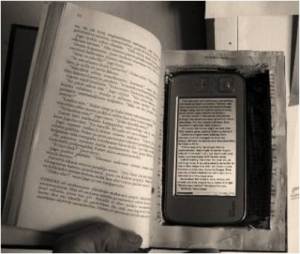
Why Bring Another Book into this World?

Here’s the transcript of the talk I’ll be giving in San Francisco next week at KA Connect 2011,

a Pecha Kucha talk entitled

“I’ll Collaborate as Long as I Can Work Alone,”

20 slides,

20 seconds each.

Let me know what you think.

Enjoy!

Randy

There’s a crisis in the profession

At 2 industry events just like this

I watched as an architect threw a chair at an invisible enemy

In both cases the speaker used the more generic “Designer” in lieu of the title “Architect”

Where’s the architect? Where’s all of my education and knowledge? Where am I? What became of me?

To quickly and effectively confront this situation head-on

I wrote a 300 page book

And published it with a traditional publisher

In just over 2 ½ years

Thoughtfully, the economy stalled my target audience’s crisis long enough for me to catch up

I started by building an online platform

An acquisitions editor on LinkedIn asks – anyone out there with a book idea?

I had one – the publisher turns it down but says those-four-magic-words:

What else you got?

Most writers have a book but no publisher

I had the enviable position of having a publisher but no book

They say the best way to have a good idea is to have lots of ideas, right?

So I send them 17 ideas for books that will stop architects from throwing chairs

The publisher selects 3

Three that they feel would make a compelling book

The publisher says: “Combine these into a book you’ve got a deal.”

There was a sense of urgency – time was running out

The architecture profession is experiencing an identity crisis

The way we communicate knowledge to one another is changing

Publishing itself is going the way of the dinosaur – books may not exist when my book comes out

Nor, for that matter, bookstores.

At the same time the publishing and construction worlds are going through enormous changes

So is our environment

The world has a problem – it is heating up

And it takes collaboration – many minds – to solve complex problems

I saw my book as a way to collect and diffuse knowledge on this subject in this time of transition

And to teach design professionals the importance of working together collaboratively.

At the same time, buildings are becoming more and more complex.

We’ll only be able to tackle today’s complex problems through collaboration

Collaboration takes work and a prepared mindset

You have to be disciplined, can’t just show up and wing it

There was a gap in learning along these lines in the profession

My book sought to fill this gap.

I may not have originally set out to write a book on BIM and Integrated Design

But together they addressed the three topics my publisher selected from those I proposed

And BIM and Integrated Design go together like peanut butter and chocolate

Like Two great tastes that taste great together.

BIM and Integrated Design are two great technologies and processes that work well together.

It is often repeated that BIM is 10% technology 90% sociology

If that’s the case, why is 90% of the energy and resources focused on the technology?

My book comes at a time when few are focusing on the people side of the change equation.

Written from a firm culture standpoint, it addresses BIM as a cultural process.

So why a book?

A book allows you to collect knowledge in one place

Tell a coherent, compelling story

Books provide immersive experiences and expose us to learning that can transform our lives

But at the same time, what we consider a book is changing.

Our communications today are ephemeral

Like writing on a mental chalk board that gets wiped clean each night

And while the internet never forgets, so much of what we write and learn – including tweets and blogs – we forget

I set out to write a book whose message will last – and stick around.

For its content to lead to critical, necessary changes in the profession and industry

I made the book essentially a collection of stories

To do so I had to write the book less like a mental black board and more like a mental bulletin board, with knowledge accumulated over time

Where the latest information in the book builds on what came before.

Technology books are notorious for becoming dated or obsolete

To ensure that the book would remain relevant

Its focus is on people, relationships, and workflow.

These subjects are not as fickle as software and computers.

Technology may come and go.

The way people behave in response to new technology, however, does not change.

I grew up with Prairie Avenue Bookshop in Chicago

With the dream that I would one day write a book and give a signing there

After 48 years in business,

Prairie Avenue Bookshop closed while I was writing the book.

Will the chance to control their chair throwing tendencies compel architects to spend $75 on my book in the midst of an economic downturn?

My network had a lot of people who have worked with the technology and work processes

and have started to formulate their own insights

So I tapped into my network and set out to interview experts

People who were working in it,

leading it, had invented it, hire and retain those who use it

And people who were teaching it.

The book addresses the number one problem of BIM : not technology, but personality

BIM and Integrated Design require a much different mindset, and this mindset requires collaboration, coordination, team work, and knowledge sharing in order to succeed.

Overcoming the real barrier, which are the people who say they want to change but in the end have a hard time doing so.

Writing this book changed my perspective on everything.

Everyone I spoke with was completely open about sharing their experiences concerning the changes they were seeing in their teams, firms and industry

It’s like the observer effect

People spoke to me openly about the subject because there is a book

And there is a book because they spoke openly with me.

We so often think of collaborating with others outside our organization

When the most effective collaboration occurs every day, internally

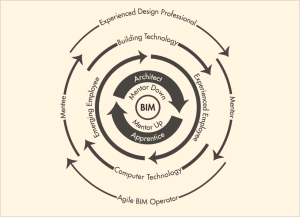
Mentoring up and down

But first, this must take place inside ourselves – our seasoned selves mentoring our emerging selves, and vice versa.

Collaboration is an inside game – and my book sought to illustrate this.

My book will provide much needed background into a topic that many architectural firms do not yet fully understand

How can BIM advance the profession of architecture?

How can collaboration assure the survival of the architect?

This is not a technology book or a process book

This is a knowledge book

A book assuring that this knowledge is not lost.

Over 100,000 books are published in the US annually

So why bring another book into this world?

To shed some light

Into the lives of those who might otherwise feel like throwing a chair

In writing the book I was reminded that ours is a universe filled with enlightened minds

It’s just that the individual voices needed to be connected

And what better place to do that than in a book?

What do you think? Are books still the best place to capture and share information and knowledge?

2 Comments

Filed under BIM, BIM expert, collaboration, design professionals, Integrated Design, people, process, workflow

System Requirements for IPD to Flourish

We all know with each release of software the computer system requirements increase.

Our computers must get more powerful as the software does.

And also as the work processes become more collaborative, with more information sharing taking place.

This is certainly the case when working in Building Information Modeling (BIM).

But how about for Integrated Project Delivery (IPD)?

In what ways do we need to grow more powerful as the 64-Bitlike process becomes more open and connected?

  • What is our capacity?
  • What are our limits for understanding and empathy?
  • What are our system requirements for working in BIM and integrated design: for ourselves, our teams and organizations?

Are we going to go through a laborious and time-consuming download of these tools and processes into our own work lives only to discover that we’re missing a key video card equivalent of attitude or mindset?

What system requirements need to be in place for IPD to take place?

  • For an integrated team made up of key stakeholders to gel early and often?
  • For team members to show all their cards, knowledge and expertise concurrently and on many levels?
  • For risk to be collectively managed and mutually shared?

7 Performance Recommendations

Here are the minimum system requirements for IPD to flourish:

1. Collaborative attitude and aptitude

A capacity and willingness to work with others and strong collaborative skills to back it up. Begins with each team member, not the project or at the organization level. Capacity to work compatibly as a team.

2. Discretionary emotional energy and enthusiasm

The passion, excitement and dedication that team members have available to give freely to the project and fellow teammates. Attempts to mandate this will lead to passive-aggressive undermining behavior. More on this here.

3. Authentic presence

Team members exhibit the capacity to maintain an authentic, non-defensive presence throughout the project. Honoring each other’s POV.

4. Climate of openness

Team members commit to telling the truth – and hearing what others have to say, even when it conflicts with one’s own beliefs or findings. Create a safe environment for concerns, issues and problems to be discussed and resolved.

5. Multidisciplinary mindset

Aspire to become a new breed of polymath – not a one trick pony – blending technology (BIM, next-generation analytics, cloud computing, sustainability, social networks,) creativity, innovation, comprehensive building knowledge with a multidisciplinary mindset.

For more on this see my article in the upcoming May/June 2011 Technology issue of DesignIntelligence, BIM Beyond Boundaries

6. Self-awareness

Each team member’s capacity to handle whatever comes their way – stress, challenges, failure. Embrace change.

7. Meaning making

Deliver not just data but meaning.

Process information for others. Not everyone on the team will be as fast an information processor as you (the human USB port.) Discover and deliver data that is relevant to the project and team.

Now it’s your turn: Can you think of any performance requirements not shown here? You’ll do all of us a world of good by letting us know by leaving a comment below.

7 Comments

Filed under BIM, collaboration, Integrated Design, Integrated Project Delivery, IPD, people, process, workflow

BIM and Integrated Design: the College Curriculum

This is a first. I don’t know of any situation where a university course – let alone a curriculum – was named after a blog.

There are no Huffington Post studies, and one would need to look long and hard for a college course named after Boing Boing.

So you can imagine my surprise to discover – in so advanced a constitutional monarchy, unitary state and country as the UK – the announcement of the launch of BIM and Integrated Design: the college course.

According to the press release put out by the university, this is a world first.

United States schools have offered advanced degree and post-professional programs related to BIM and IPD as a delivery method for some time. Illinois Institute of Technology (IIT) Master of Integrated Building Delivery program is but one example.

But never before has there been one specifically on the topic of BIM and Integrated Design.

As described in the course syllabus, this BIM and Integrated Design program is unique in that it approaches integrated design processes from a Lean design and construction perspective, with the use of enabling technologies - BIM and sustainability.

Also addressed in the program are the benefits that can be achieved through the adoption of BIM, including integrated processes; improved design coordination, information management and exchange; clash detection; clearer scheduling; improved sustainability outcomes; and improved value to clients and users.

While this looks like a lot of information to cover in a school curriculum, it is heartening to see that the considerable collaborative work processes of BIM – impacting individuals, organizations and the industry – are emphasized in the course as well.

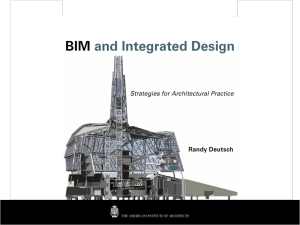
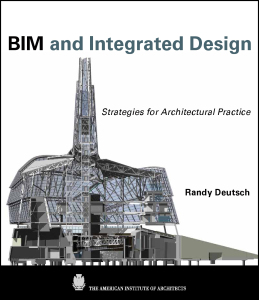
The BIM and Integrated Design program launches in September 2011 – coinciding with the release of my new book: BIM and Integrated Design: Strategies for Architectural Practice (John Wiley & Sons).

Read on for the full press release. Schools here would benefit from such a well-written article announcing new BIM and IPD-related courses and curricula.

At the end of this post is a link to a detailed description of the proposed course.

Skills gap warning as BIM becomes mandatory requirement

UK construction and design industry professionals must invest in skills training if they are to embrace the forthcoming implementation of Building Information Modeling (BIM). That is the view of Arto Kiviniemi, Professor of Digital Architectural Design at Salford University’s School of the Built Environment which today launches the world’s first MSc course on BIM and Integrated Design.
The government’s chief construction adviser Paul Morrell has indicated that BIM will become a key part of the government’s procurement of public buildings and that bidders and contractors on future public building projects would be expected to implement it on all future projects. A team is currently studying the use of BIM in government projects and will report its findings to the Construction Clients Board in March.
Integrated BIM means a fundamental change in the design, construction and facility management processes that involves data sharing between all shareholders based on digital models that can be used from a project’s early design stages through to completion and monitoring of subsequent performance.
The news that BIM will become mandatory in all public procurement has been met with some skepticism from the industry in the UK but Kiviniemi, one of the world’s leading authorities on BIM, has seen the benefits of the delivery of BIM across the US and Scandinavia, where it has been demanded by large public clients since 2007.
He explains: “In Scandinavia and the US public projects now use BIM and there is no doubt that it will become the standard in the UK and across Europe. It integrates the information that architects, engineers and contractors must deliver on a project and creates data which is usable in the integrated processes, simulations and life cycle management of buildings”.
“To make this work it is essential to share the data in open BIM format. The efficient utilization of data helps clients to make informed decisions and will enable our industry to respond to the environmental challenges, as well as to increase the productivity if we develop our processes too. There are definitely some strong success stories and evidence of measurable benefits if you look at the international studies of BIM and IPD (Integrated Project Delivery).”
He warns: “Those who have not embraced BIM will be simply out of the running for public projects.”

The government’s introduction of BIM is designed to unlock new ways of working that will reduce cost and add long-term value to the development and management of built assets in the public sector. Paul Morrell has said that he hoped that the report would mark the beginning of a commitment to a timed programme of transformation and adoption.
Adopting an industry-wide BIM process is likely to reveal a significant learning gap in many companies with people left wondering how to implement this into their own practice. In response the School of the Built Environment at the University of Salford has launched a unique programme of Building Information Modeling and Integrated Design which commences in September 2011.
The course is designed to promote a deeper understanding of the impacts and business benefits of adopting integrated BIM on the supply chain organizations. It is aimed at design professionals, e.g. architects, architectural technologists, structural and M&E engineers, and design/project managers and will give companies a head start in implementing a BIM-based approach.

Look here for more information about the Masters Degree in BIM and Integrated Design.

7 Comments

Filed under BIM, BIM instructor, collaboration, Integrated Design, Integrated Project Delivery, IPD, modeling, process, workflow

He’s just not that into you…or BIM

Today I’m going to introduce you to a new acronym.

That’s right. One more.

Just this last one, then we’re through. Done. Kaput. I promise.

You ready? Good.

JAT

There, that wasn’t so bad. Right?

It’s short for

Just a Tool

As in…

Well, you know.

The oft heard sentiment that

“BIM is just a tool”

Here, it’s the word “just” – not “tool” – that triggers my outrage.

And this rant.

So, fasten your seatbelts.

Not “just.”

BIM is not “just” anything.

This blog’s brand is more horse feathers than high horse, more horse sense than nonsense – so accept what I’m about to say as an exception to the rule.

My anger – and incredulousness (yes, it’s a word) – in online discussions and interviews.

The nonchalance of those who declare that

“That’s not a BIM problem.”

As in

“I have a hospital to design in a seismic zone and I have no time to do it. That’s not a BIM problem.”

Or

“That’s not an issue brought about by BIM.”

That BIM is “just a tool” – like it’s just a can opener or a pair of pliers or a hammer.

If you only have a hammer, you tend to see every problem as a nail.

- Abraham Maslow

“If we didn’t have it – we’d use something else.”

As in

“No Revit? No problem. I’ll use a stapler.”

At least until BIM becomes a staple in the industry.

These dismissives come from those who are immersed in the technology

Like fish who, it is said, cannot discover water – or like Madge in the 70’s Palmolive ads

You’re soaking in it

They swat away the insinuation that what they are using or doing is anything more than a revved-up 2H pencil with an off-handed dismissive sweep of the hand like they were swatting flies.

But a tool?!

The way that the iPhone is just a tool.

Or the GPS is just a tool.

Or the human brain…

Only that BIM is ALL of these in one.

And the add-ons are BIM’s apps.

App-like tools available for every part of the BIM process.

BIM is not a tool, authoring, analyzing or otherwise.

Apps are tools, I’ll concede you that.

BIM is…

BIM is a process

BIM is our saving grace

BIM is our ticket to ride

BIM is our pass out of here

BIM is our card that says pass GO

BIM is our last golden ticket

BIM is our salvation

BIM is the innards of an intricate clock

BIM is the white horse you rode in on

BIM is the deus ex machina – that arrives at the end of the play to save everything

BIM, the enabler

BIM, the balm

BIM makes IPD possible

And also likely, relevant, necessary and inevitable.

BIM is more than what’s happening on your desktop.

No one would say

BIM is just a process.

BIM is just a strategy.

BIM is not just a technology: software is.

BIM is a disruptive technology. And…

BIM requires that you just focus less on Revit, ArchiCAD and their add-ons and more on process and strategy

BIM is a product

BIM is an IT-enabled, open standards based deliverable and collaborative process

BIM is a facility life-cycle management requirement

BIM is a fundamentally different way of creating, using, and sharing building lifecycle data

BIM is just evolving and will continue to as the capabilities of user and technology improve

BIM can serve as a reliable basis for decision making

BIM is a rebirth of excitement and hope. (T/Y Alberto Palomino, master of the poetry and metaphysics of BIM)

No one asks “Can peanut butter exist without jelly?”

Yes, BIM can exist without IPD as IPD can work without BIM

Just as peanut butter can exist without jelly.

But

WHY ON EARTH WOULD ANYONE WANT TO DO THAT?!

And yes,

BIM is a pretty amazing, evolved, in-process of developing, still in-progress

Tool.

But a pretty amazing one at that. And…

Get on your high horses, people – the Age of Aquarius for design professionals is upon us.

Just as HAL – the fictional computer in Space Odyssey – plus one letter in the alphabet is IBM (H<I, A<B, L<M) so too CAD minus one letter is BIM*

*Except for the last two letters. Shucks.

Definitions of Just BIM

No one would ever say

BIM? It’s just a computable representation of the physical and functional characteristics of a facility.

or

BIM is just information use, reuse, and exchange just with integrated 3D-2D model-based technology. No big deal.

or

BIM is just a single repository including both graphical and non-graphical documents – that’s all.

or even

BIM is just a building design and documentation methodology characterized by the creation and use of coordinated, internally consistent computable information about a building project in design and construction. Nothing more, really.

Why qualify it?

So fuggedaboutit.

There’s no need for the acronym JAT.

BIM isn’t “just” any thing.

So stop saying it.

BIM just is.

10 Comments

Filed under BIM, defining BIM, process, workflow

T-Shaped BIM

Every now and then a simple, seemingly obvious concept comes around that transforms an entire industry. This post will introduce such a concept: the T-shaped BIM teammate.

Here, we are of course not talking about forming a T-shaped connection of walls in Revit. If you came here wanting to learn how to intersect walls in BIM, you’re a fool. Go here.

The rest of you, stick around. You might learn something important.

And, as in past posts, it is not actually BIM that is T-shaped – it is you. Or Tu – French and familiar for you.

Some people are put-off by the word collaboration – and for that reason I am going to refrain from using it again in this post.

For them – the word – implies compromise, time-wasting, money-wasting, talent-wasting, and perhaps worst of all, people- and process-oriented as opposed to product- or building-oriented interactions.

To them, people are impediments to progress, not the lubricant that makes things flow. Perpetually in search of workarounds –they work around people whom they believe keep them from completing their work. You know the type.

The social case for BIM and Integrated Design

Integrated Design came into being for one reason and one reason alone: to achieve greater results for the owner and other project stakeholders. Including you.

There’s a compelling business case for working in integrated design: it enables the efficient and effective use of tools such as BIM and related technologies.

There’s a compelling technology case for working in integrated design: it potentially makes more efficient shared use of the software and work processes.

And there’s a compelling people case for working in integrated design: by colla- – by working with others, working together, cooperating traitorously or treasonously, sharing knowledge, learning and building consensus – you and your team both can attain greater results.

Admittedly, not every project lends itself to the advantages of working co- co- co- together. For example, due to project size, schedule or client demands.

There’s another way to look at – working jointly – that may appeal to you more and potentially change the way you work from here on out.

The “|” in DIY

I used to work with someone who did it all himself. If there was a new program a project had to be accomplished in he’d learn it himself and do the work himself – even when he had several talented and eager others at his disposal. That way he knew the work was going to get done right. In a previous post I labeled this type of colleague’s approach DIY. I wrote about this concept – DIY vs. SxS – a while back here and will be speaking about it in a couple weeks at Christopher Parsons’s KA Connect 2010 here and here.

When he worked with others he thought he was delegating by handing-off tasks he didn’t want to do, but what he was doing was abdicating his role.

He was an “I” and as we know, there is no “I” in BIM

And as has been noted, no “I” in IPD either.

The T in archiTecT is more important, noteworthy, prominent and if you will, architectural, than the “I” in archItect or arch|tect which is divisive, isolating and dissenting.

“I” is a barrier – a barrier to co- co- co- cooperation – and as with the compelling and popular blog title Arch | Tech can imply a barrier between design and technology – or even design and construction – instead of stitching them together.

But the “|” doesn’t have to be an obstruction or impediment.

“|” can also be a net - as when Robert Frost famously opined that writing free verse is like playing tennis without a net.

Which is how I interpret the “|” in Arch | Tech, as a net between design and technology, lobbying the BIM back and forth.

As well, for that matter, as the “|” in BIM – volleying the model back and forth between design and construction, weaving a single unified model for use by all.

But | digress.

The ideal T-shaped BIM teammate

Right now you’re happy to find an engineer or consultant that works in BIM. Period. No matter their shape – or what shape their in.

But in time, as BIM becomes ubimquitous, you will start to add another level of criteria as you put teams together.

You will start to require that all your Team members be T-shaped and you will want to Team with other T-shaped professionals.

And because They will want to Team with T-shaped Teammates, you will Take it upon yourself to become T-shaped yourself.

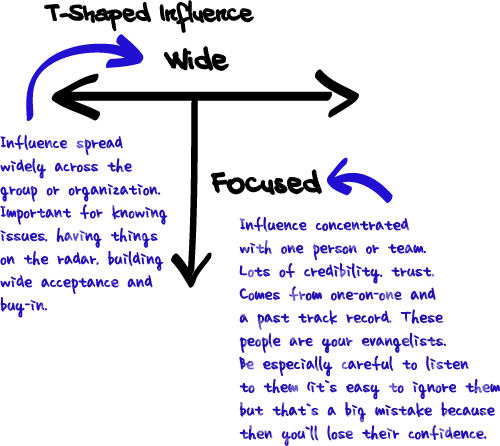
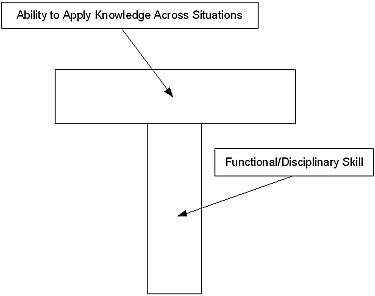
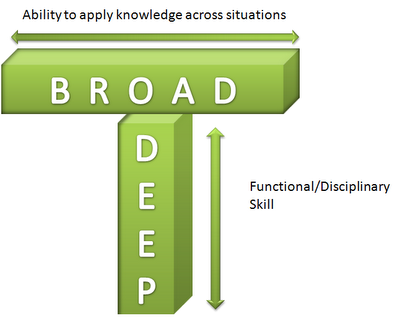
The ideal candidate/colleague/teammate working in BIM and Integrated Design has both of these qualities

  • Deep skills
  • Broad reach

The vertical “I” or “|” represents what you do well – your depth.

The horizontal bar across the top is your reach – reaching out to assist others.

And as importantly being assisted by them.

Place the bar atop the “I” and you get the T-shaped BIM Teammate.

By becoming T-shaped you are putting on two performances:

  • 1. results in your own position (the “I” or vertical stanchion) and
  • 2. results by co- co- conjugating with others on your team (the horizontal bar resting atop the “T”)

T-shaped BIM Teammates do two things really well. They

  • reciprocate in that they are willing to share information and ask for information when needed
  • are rewarded for their own performance as well as for contributing to others on the team

Read more about this important concept here and here.

What causes a person with deep skills but little wingspan to suddenly reach out to share information with her teammates? Namely this: empathy

Tim Brown, CEO and president of IDEO, alludes to the role empathy plays in the T-shaped person

We look for people who are so inquisitive about the world that they’re willing to try to do what you do. We call them “T-shaped people.” They have a principal skill that describes the vertical leg of the T — they’re mechanical engineers or industrial designers. But they are so empathetic that they can branch out into other skills, such as anthropology, and do them as well. They are able to explore insights from many different perspectives and recognize patterns of behavior that point to a universal human need. That’s what you’re after at this point — patterns that yield ideas.

You can read more about what Tim has to say On Being T-shaped here and read an incisive interview with Tim where he discusses being Mr. T here

Still not convinced – or for that matter – entertained? Then take this and call me in the morning.

It should be apparent by now that the T-bone concept may be new to BIM – but not to the world of IT and computing. The first citation to T-shaped people goes back almost 20 years to David Guest, “The hunt is on for the Renaissance Man of computing,” The Independent (London), September 17, 1991. Read it here.

Soon, our Integrated Design teams will be made up exclusively with T-shaped individuals.

Made up, that is, of archiTecTs, conTracTors, consultanTs and clienTs with both deep skills and wide reach.

In time, our teams will begin to resemble something of a T-shaped chorus line

TTTTTTTTTTTTTTTTTTTTTTTTT

which, perchance, resembles a bridge or aqueduct

TTTTTTTTTTTTTTTTTTTTTTTTTTTT

an apt image and timeless symbol for carrying the client’s goals toward exceptional results.

Simply sea-changing.

10 Comments

Filed under BIM, collaboration, design professionals, Integrated Design, modeling, people, process, workflow

BIM as though People Mattered

If you want to foster creativity and excellence, you have to introduce some boundaries. Teams need some privacy from one another to develop unique approaches to any kind of competition. Scientists need some time in private before publication to get their results in order. Making everything open all the time creates what I call a global mush. Jaron Lanier You Are Not a Gadget: A Manifesto

This post will introduce you to a book that will change society and alter the future.

But first, some back story.

The other night I was parked outside a bike shop near my home whose storefront window read: Body Machine Integration (BMI)

Being at one with their vehicle clearly appealed to the somnambulist bicyclists inside.

Sometimes Building Information Modeling (BIM) has us feeling like Bodily Integrated Machines (BIM).

After a long day modeling it is easy to feel like we have to call someone over to our workstation to pry us away from our machines.

We now work and live in environments where the line between you and your screen is becoming thinner and thinner.

Promotional materials for BIM products suggests that they “think like an architect” but all too often you discover that you have to think like your software.

This is old stuff for those that have worked in CAD – who, after a long day at work, would fall asleep at night only to dream that they were inserted in a CAD drawing.

Thinking in abbreviated commands and talking in macros.

MIT’s William J. Mitchell has long warned – or promised, depending on your outlook – about our evolving into cyborgs.

But that’s not the book, nor the author, that will make a sign post of 2010.

Voodoo Architecture

So I naturally googled Body Machine Integration for architects and came up with…Archibots? Archibots are the latest thing in the emerging area of “Architectural Robotics” – intelligent and adaptable physical environments at all scales.

It is somewhat comforting to know that this is about robotic technologies embedded in the built environment – not people.

Soon you’ll have the opportunity to hire one of these to do your drafting – or better yet, input information into your BIM.

Archibots: a workshop on intelligent and adaptable built environments was held last Fall by students at Clemson U.

The second fragment of this stop-motion video from the event – from a collection of stop-motion vision videos created by participants in the Archibots workshop – indicates the possibility of modifying an as-built BIM model has the parallel effect on the actual built building the model represents. Almost like a voodoo doll.

Voodoo architecture where you modify the model and the building changes.

My office is missing! Who left the model unlocked again?!

Imagine where you drag-and-drop materials and textures off of your laptop screen onto adjacent surfaces.

And they become those surfaces.

Where the line between you and your screen disappears, the two become indistinguishable.

It gets you thinking about where things are going (holograms, artificial intelligence, singularity, according to designintelligence.)

One day, everyday robotics embedded in our built environment will increasingly support and augment work, school, entertainment, leisure activities - as well as the construction industry - in an increasingly digital society.

You Are Not a Gadget: A Manifesto

Which brings us to Jaron Lanier, the 1980s Silicon Valley dreadlocked visionary who coined the term virtual reality and was among the first to predict the revolutionary changes the internet would bring to the worlds commerce and culture, and has now written a long-awaited book: You Are Not a Gadget: A Manifesto, an editor’s selection Best Book of the Month.

You Are Not a Gadget is being called “a useful, respectful dialogue about how we can shape technology to fit culture’s needs, rather than the way technology currently shapes us.”

It is also being called a “most thought-provoking, human, and inspiring critique of the computerized world of information that has yet been written.”

In the book, Lanier discusses the technical and cultural problems that can grow out of poorly considered digital design, and cautions against the current Web 2.0 fad which elevates the wisdom of the hive mind over the intelligence and judgment of individuals.

In You Are Not a Gadget, Lanier argues that the idea of collective is smarter than the individual is wrong. Why is this?

Here’s Jaron Lanier on Collaboration: There are some cases where a group of people can do a better job of solving certain kinds of problems than individuals. One example is setting a price in a marketplace. Another example is an election process to choose a politician. All such examples involve what can be called optimization, where the concerns of many individuals are reconciled. There are other cases that involve creativity and imagination. A crowd process generally fails in these cases. The phrase “Design by Committee” is treated as derogatory for good reason. That is why a collective of programmers can copy UNIX but cannot invent the iPhone.

Biological cells have walls, academics employ temporary secrecy before they publish, and real authors with real voices might want to polish a text before releasing it. In all these cases, encapsulation is what allows for the possibility of testing and feedback that enables a quest for excellence. To be constantly diffused in a global mush is to embrace mundanity.

Here’s Jaron Lanier on Intellectual Content: On one level, the Internet has become anti-intellectual because Web 2.0 collectivism has killed the individual voice. It is increasingly disheartening to write about any topic in depth these days, because people will only read what the first link from a search engine directs them to…Or, if the issue is contentious, people will congregate into partisan online bubbles in which their views are reinforced. I don’t think a collective voice can be effective for many topics, such as history-and neither can a partisan mob. Collectives have a power to distort history in a way that damages minority viewpoints and calcifies the art of interpretation. Only the quirkiness of considered individual expression can cut through the nonsense of mob-and that is the reason intellectual activity is important.

A must read.

BIM as though people mattered

Here are 10 things you can do to keep the body-machine integration at bay – and help you to remain you human and keep your feelings alive – while building information models:

  • Spend time in nature
  • Sit in front of a favorite painting at the museum over lunch
  • Read a poem
  • Keep your passion for architecture alive by revisiting the work you love & admire
  • Or get a daily dose of architecture here
  • Know yourself, your preferences, by cutting out things that appeal to you at a visceral level (no thinking required) and by keeping a file of these images
  • Keep a list of the things you know for certain that you like, love, enamor and return to it often for sustenance
  • Read The Heart Aroused: Poetry and the Preservation of the Soul in Corporate America
  • Keep your passion for work alive by remaining awake at work
  • Listen to your favorite music every day (you know where to find it)
  • Watch The Diving Bell and the Butterfly, A Single Man or another film directed by a visual artist

What are some of the things you recommend doing to keep it real and stay human in the face of the technological forces at work?

Leave a comment

Filed under BIM, collaboration, Integrated Design, modeling, people, Uncategorized