Category Archives: defining BIM

He’s just not that into you…or BIM

Today I’m going to introduce you to a new acronym.

That’s right. One more.

Just this last one, then we’re through. Done. Kaput. I promise.

You ready? Good.

JAT

There, that wasn’t so bad. Right?

It’s short for

Just a Tool

As in…

Well, you know.

The oft heard sentiment that

“BIM is just a tool”

Here, it’s the word “just” – not “tool” – that triggers my outrage.

And this rant.

So, fasten your seatbelts.

Not “just.”

BIM is not “just” anything.

This blog’s brand is more horse feathers than high horse, more horse sense than nonsense – so accept what I’m about to say as an exception to the rule.

My anger – and incredulousness (yes, it’s a word) – in online discussions and interviews.

The nonchalance of those who declare that

“That’s not a BIM problem.”

As in

“I have a hospital to design in a seismic zone and I have no time to do it. That’s not a BIM problem.”

Or

“That’s not an issue brought about by BIM.”

That BIM is “just a tool” – like it’s just a can opener or a pair of pliers or a hammer.

If you only have a hammer, you tend to see every problem as a nail.

- Abraham Maslow

“If we didn’t have it – we’d use something else.”

As in

“No Revit? No problem. I’ll use a stapler.”

At least until BIM becomes a staple in the industry.

These dismissives come from those who are immersed in the technology

Like fish who, it is said, cannot discover water – or like Madge in the 70’s Palmolive ads

You’re soaking in it

They swat away the insinuation that what they are using or doing is anything more than a revved-up 2H pencil with an off-handed dismissive sweep of the hand like they were swatting flies.

But a tool?!

The way that the iPhone is just a tool.

Or the GPS is just a tool.

Or the human brain…

Only that BIM is ALL of these in one.

And the add-ons are BIM’s apps.

App-like tools available for every part of the BIM process.

BIM is not a tool, authoring, analyzing or otherwise.

Apps are tools, I’ll concede you that.

BIM is…

BIM is a process

BIM is our saving grace

BIM is our ticket to ride

BIM is our pass out of here

BIM is our card that says pass GO

BIM is our last golden ticket

BIM is our salvation

BIM is the innards of an intricate clock

BIM is the white horse you rode in on

BIM is the deus ex machina – that arrives at the end of the play to save everything

BIM, the enabler

BIM, the balm

BIM makes IPD possible

And also likely, relevant, necessary and inevitable.

BIM is more than what’s happening on your desktop.

No one would say

BIM is just a process.

BIM is just a strategy.

BIM is not just a technology: software is.

BIM is a disruptive technology. And…

BIM requires that you just focus less on Revit, ArchiCAD and their add-ons and more on process and strategy

BIM is a product

BIM is an IT-enabled, open standards based deliverable and collaborative process

BIM is a facility life-cycle management requirement

BIM is a fundamentally different way of creating, using, and sharing building lifecycle data

BIM is just evolving and will continue to as the capabilities of user and technology improve

BIM can serve as a reliable basis for decision making

BIM is a rebirth of excitement and hope. (T/Y Alberto Palomino, master of the poetry and metaphysics of BIM)

No one asks “Can peanut butter exist without jelly?”

Yes, BIM can exist without IPD as IPD can work without BIM

Just as peanut butter can exist without jelly.

But

WHY ON EARTH WOULD ANYONE WANT TO DO THAT?!

And yes,

BIM is a pretty amazing, evolved, in-process of developing, still in-progress

Tool.

But a pretty amazing one at that. And…

Get on your high horses, people – the Age of Aquarius for design professionals is upon us.

Just as HAL – the fictional computer in Space Odyssey – plus one letter in the alphabet is IBM (H<I, A<B, L<M) so too CAD minus one letter is BIM*

*Except for the last two letters. Shucks.

Definitions of Just BIM

No one would ever say

BIM? It’s just a computable representation of the physical and functional characteristics of a facility.

or

BIM is just information use, reuse, and exchange just with integrated 3D-2D model-based technology. No big deal.

or

BIM is just a single repository including both graphical and non-graphical documents – that’s all.

or even

BIM is just a building design and documentation methodology characterized by the creation and use of coordinated, internally consistent computable information about a building project in design and construction. Nothing more, really.

Why qualify it?

So fuggedaboutit.

There’s no need for the acronym JAT.

BIM isn’t “just” any thing.

So stop saying it.

BIM just is.

10 Comments

Filed under BIM, defining BIM, process, workflow

Fixing our Gaze on BIM and Integrated Design

I want the unobtainable. Other artists paint a bridge, a house, a boat, and that’s the end. I want to paint the air which surrounds the bridge, the house, the boat, the beauty of the air in which these objects are located, and that is nothing short of impossible.

- Claude Monet

I’ve come across a book that I’d like to share with you. A science book that has some pertinent lessons for those working in BIM – or seriously considering doing so.

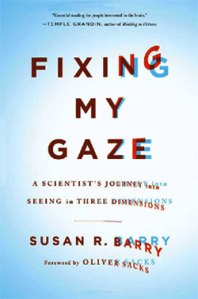
In Fixing My Gaze: A Scientist’s Journey into Seeing in Three Dimensions, by Susan R. Barry with a foreword by Oliver Sacks, Barry describes how miraculous it is after 50 years to suddenly be able to see in 3D for the first time.

The memoir is a fascinating account of Sue Barry’s acquisition of stereo-vision at an adult age.

In the book she reveals step-by-step how this new 3D world was revealed to her. And shows how her experiences are not, in the end, unique.

Barry, a neuroscientist, was born with her eyes crossed and literally couldn’t see in all three dimensions. The author, a professor of Neuroscience, remained unable to see in 3D for most of her life.

She was missing depth perception, that visual ability to judge what is closer and farther away.

Everything appeared flat to her.

Snow, for example, would appear to fall in a flat sheet in one plane in front of her.

Barry tells the story of how she was able to learn from others how to successfully correct her vision as an adult.

And how she recovered depth perception when she was 50 after visual therapy with a developmental optometrist.

In her late 40’s Barry was referred to an Optometrist not far from the University where she taught and did research. The Optometrist evaluated her and determined that with a prescribed program of vision therapy, Barry might gain binocular vision. After some hard work, Sue Barry was able to see in 3D.

The book asks and answers: If deliberate effort can rewire sensory processing at 50, what other astounding feats might our brain manage with the right training?

11 Lessons from Fixing My Gaze

“…the brain is a marvelously plastic organ that can continue to change its wiring and thereby its function throughout our adult life.”

- Eric Kandel, Winner of the Nobel Prize in Physiology/Medicine

Read Fixing My Gaze if interested in learning how the brain can adapt and change at any stage of life due to the plasticity of the brain through training.

The story of “Stereo Sue” regaining her depth perception at age 50 and astonishing the medical community was first told in a 2006 article by Oliver Sacks in the New Yorker.

Hear Sue’s story on NPR Morning Edition.

Or read on for 11 LESSONS that can be extracted from the inspiring book.

Lesson 1: While working in 2D made us all bystanders, working in BIM puts you in the middle of things.

In the book, a visit to Manhattan surprises Barry with skyscrapers that no longer appear as a flat backdrop.

Before acquiring 3D vision, Barry’s 2D existence felt as though she was looking into a snowfall.

From the outside. On the outside, looking in.

Whereas once she trained herself to think in 3D, she felt herself to be within the snowfall, among the flakes. She found herself surrounded by and immersed in life.

Working in BIM once again makes us participants in the design and construction process.

Lesson 2: The Eye in BIM

While the “I” stands for information, could it also stand for “eye?”

Appreciate the many ways that BIM allows us to see things that we were formally unable – or unwilling – to see.

Lesson 3: The Vision Thing

Hindsight, Insight, Foresight.

It’s not for nothing that our projects are located on a site.

The book teaches us that Sue, like many others, who want to experience their worlds in 3D find ways to work around their uncoordinated vision.

The brain does amazing things to compensate for visual deficiencies and retraining shows what’s possible.

Just like those of us working in BIM, by coming up with makeshift, piecemeal workarounds.

Where there’s a will, there’s a way.

Those who have a ‘why’ can bear with almost any ‘how.’

- after Viktor Frankl

Lesson 4: Just a Tool

To say BIM is just a tool is like saying the eye is just a tool.

It’s the profane, rational thing to say.

And it’s wrong.

When you take in their complexity and all that they can accomplish – it is easy to see that both the eye and BIM are more than tools.

We ought to treat them that way.

Barry says that those with 2D vision and those with 3D vision speak different languages.

BIM and sight are processes – not singular things. The more dimensions we afford them, the easier this is to see.

Lesson 5: Fixing our Gaze

As with the three-letter acronym BIM, the three-letter word “fix” has many definitions.

Fix can mean – in need of repair, as in fixing it

To restore by replacing a part or putting together what is torn or broken.

The implication is that we’re broken in some way and we need repair.

To be fixed.

There’s a great deal in our profession and industry that requires fixing.

Your role working in BIM is to fix what doesn’t work. Don’t limit yourself to just one dimension or definition of what it means to work in BIM.

There’s the common use of fix to prepare or cook, as well as to situate: put something, somewhere firmly.

To fasten, to firmly attach, as to a cause.

Hitch your wagon to a star.

- Emerson.

But to fix can mean to fix our gaze.

To set it, stop it, position it.

On what is important.

Lesson 6: The future is closer than you think

Like the Far Side Cartoon of the car side mirror filled with the huge bug eye with the caption that read: Objects in the mirror appear further than they actually are.

In transforming ourselves from 2D to 3D – from thinking in 3D to communicating in 3D – and with it the attendant realities, there’s no more faking it – in BIM there’s nowhere to hide.

Our models are warts-and-all stories.

Closer to reality than to fantasy, threatening to our associative sensibilities.

Lesson 7: Seeing in 3D takes courage

We don’t give ourselves enough credit.

If author Barry could acquire stereo-vision – the ability to see in 3D – so can you, no matter your role or career position.

Those of us brought up on 2D CAD are committing to fixing our gaze and acquiring stereo-vision.

Going from analog-vision of hand drawing and mono-vision of 2D to stereo-vision of working in 3D.

The book tells a story of perseverance in overcoming obstacles. Obstacles we all must overcome in moving from 2D documentation to 3D design and virtual construction.

Like the author, find and identify success stories of your own.

Lesson 8: We take seeing in 3D – and working in BIM – for granted

Barry had to learn to see in 3D, something that most of us take for granted.

We as design professionals and those working in the construction industry suffered from our own lack of depth perception.

In that we’re not looking at our tools deeply enough.

By viscerally identifying with her 2D life and appreciating her 3D discoveries, as readers we’re able to understand a little of the 3D world to which we’re currently blind.

As with Flatland, many of us still find ourselves seeing in only 2 dimensions, as though we were stuck in CAD.

Ask yourself: When did you first realize that you couldn’t see in 3D?

Architects see in 3D from near the beginning of their careers. What they don’t necessarily do is work in 3D.

All you have to do is think of people like Sue Barry to realize:

You have advantages others do not have and take these for granted.

The book covers the science behind our vision, particularly how it is that we see in three dimensions. Science that we take for granted.

If you have acquired the software.

If you have implemented BIM.

If you have mastered it.

Take a moment now to honor yourself.

You have accomplished something great and profound.

Something that will not only help you, your firm, the contractor and owner but also the profession and industry.

When you learn to work in BIM you are helping others achieve their goals.

Mastering BIM – as you help yourself – you are helping others.

Lesson 9: Depth Charge

From the time of the Renaissance, artists have made use of tricks and cues to create a sense of depth to endow their art work with a sense of life.As BIM endows a stalled profession with a sense of life.

Working in 3D ought to invigorate our senses and shake up our composure.

Professor Barry’s renaissance with her newfound abilities will motivate you to be a serious student again in all it is you still have to learn.

Working in architecture becomes exciting again.

Give yourself the gift of depth perception.

Lesson 10: Keep Things Whole
Once, seeing - and working - in 2D was all we knew.
The equivalent of working in little bim without taking the additional dimensional leap into BIG BIM.

Working in BIM completes us as design professionals.

BIM is the quality that gives the architect dimensionality.

Design plus construction. Tool plus process. BIM plus IPD.

Look for that hidden wholeness.

Lesson 11: Knowing vs. Doing

Perception is not something that happens to us, or in us. It is something that we do.

- Alva Noe, Action in Perception

Today the 3D world of BIM is revealed to us in myriad ways.

In articles, webinars, classes, training sessions, in blogs, in books, in the office.

But knowing BIM is not enough.

Sue, a neuroscientist, knew practically everything there was to know about seeing in 3D or stereopsis, but her world and joy of seeing changed profoundly when she experienced 3D vision.

Knowledge of BIM is not enough – you have to experience it for yourself.

5 Comments

Filed under BIM, BIM expert, BIM trainer, construction industry, defining BIM, design professionals, education, Integrated Project Delivery, IPD

The ABCs of BIM and Integrated Design

As an experiment this morning I opened the keyword index of the Architect’s Handbook of Professional Practice (AHPP) to see just how much the architecture profession – and the way we practice – changes due to the advent of BIM and the collaborative process of Integrated Design enabled by this technology. No matter where you find yourself on the BIM journey – training, transitioning or trial-and-error – the world of architecture we are told is about to be turned on its head and all of us will be expected to learn our ABCs all over again. Start now – from A – and don’t let this be an alphabet of regret and remorse but rather the beginnings of a BIM Dictionary, A Bim Ctionary, or if you prefer, a BIMtionary. For here we are not focused on BIM-related words – we have BIM glossaries for that – but instead, and more importantly, our BIM DNA.

A

Architects and Standard of Care

BIM causes the Standard of Care to evolve. Because BIM results in a model – and indirectly, documents – that are more accurate and exact – the expectation inevitably will be for architects and their work to rise to this new watermark. Architects will be expected to work in BIM.

Accreditation: School

To receive accreditation schools will need to prepare students for working in a BIM environment. Whether BIM is taught in the school program or whether students will be required to pick up the software themselves on their own time is being debated. One thing is certain – recent graduates will be expected to know how to communicate well, collaborate effectively and know how a building is put together.

Alternative Careers

With 50% of recent architecture school graduates going on to work at something other than traditional architectural practice, schools will need to determine if the time, cost and energy learning BIM software would be better allocated on more transferable skills – such as working simultaneously at multiple scales, orchestrating large teams and translating ideas from one media to another. Those that take the time to learn BIM either gain confidence with the accomplishment – or feel deficient – due to how overwhelming it can be.

Architect Selection

A non-starter. Already in Wisconsin and Texas BIM is required on state-supported projects. If you do not now use BIM you cannot compete for this work. And when you do decide to take it on – other will be able to say that they have been using it for years.

Acquiring Capital

Banks will require projects to be designed, modeled and built virtually in BIM in order to be assured that loans are based on accurate estimates of construction cost, that there are fewer delays and loan amounts are not exceeded.

B

Bidding and Negotiation

In the eight phases of Integrated Design (Conceptualization phase – or expanded Programming; Criteria design phase – or expanded Schematic Design; Detailed Design phase – or expanded Design Development; Implementation Documents phase – the former Construction Documents; Agency Review, Buyout, Construction phase and Closeout phases) Bidding and Negotiation will be replaced by Buyout. Because of the accuracy of the model the project will be a known entity: there will be nothing to bid or negotiate.

Banking and Bankers

See Acquiring Capital above.

Basic Services

As with the Standard of Care, you might be able for the short term to leverage BIM and its accoutrements as an additional service for which you are compensated. But soon, as BIM becomes the norm and more so – ubiquitous – it will be an expected service.

Building Codes

We will soon see building codes incorporated into BIM (IBC plug-in and ADA App anyone?) These programs will flag discrepancies and identify non-conforming work and perhaps more importantly for design will set limits – constraints – to work within, alerting us when we’ve exceeded set boundaries.

C

Computerizing the Firm

How quaint.

Change Orders

With BIM, these will go the way of Maylines, pin bars and 2D CAD. Relics of an earlier age and process – their presence and need will be greatly diminished. Unless of course they are due to someone changing their mind, human nature being what it is. Those in the industry will need to find another method for profit-making. Integrated Design has taken care of that – with the concept of shared risk and shared reward.

Client Management

Because owners are an integral part of the team meeting in the iRoom, managing and orchestrating clients around the BIM model becomes all the more critical. With less left to the imagination – and less opportunity to “wow” them – new strategies will need to be developed by the architect to manage client’s expectations, perceptions and understandings.

Communications Management

BIM disrupts and radically changes office and team workflows. The way you communicated before – both internally and externally with consultants, engineers and others – has become transformed in the BIM environment. Learning how to communicate effectively with those working in the model both in the office and utilizing collaborative communication tools will become a priority for all involved in the process if only due to the change in the way decisions are made – and when they are made.

Compensation and Promotions

Architects in Integrated Design share risk and reward and can market their BIM capabilities. Architect employees immersed in the BIM world for the time being can demand greater personal compensation. At least until the playing field levels off…

As for promotions, firm leadership will debate the role and importance of being technically savvy and adept at BIM to attaining a senior management position or other coveted role within the firm. While working exclusively in BIM is not a substitute for becoming and being a well-rounded architect with other highly developed attributes and aptitudes – more and more it will become a factor in who will lead firms and the profession.

Construction Cost Management

An indisputable win for BIM, driven by the reliability and accuracy of the information in the BIM model.

Phrases such as “BIM represents a sea change” and “BIM levels the playing field” that are thrown about imply that “BIM is a whole new ballgame” when in fact – at least for now, you are the same architect, working in the same firm in the same profession. In other words – more has stayed the same and less has changed than you give credit for. It’s the same profession – with BIM or without – and we’re the same professionals, using new, advanced tools to play our parts in the worlds of design and construction. And yet – we sense – not far on the horizon that these worlds are swiftly converging. It’s all right there in the Architect’s Handbook of Professional Practice – the old standby – reliably reminding us, when we bother to look, who we are and what we do. In the next post we’ll look at letters “DEF,” but until then realize this: that BIM doesn’t change things so much as shed light, rendering the alphabet of our chosen profession lucid, apparent, remarkable in a way that we have not seen it in our lifetime.

3 Comments

Filed under BIM, defining BIM, Integrated Design

BIM and the Elephant Problem

“With notoriously bad eyesight, forest elephants tend to follow their trunks, using the appendage as a blind person might use fingertips on a stranger’s face-to identify, visualize, gather clues, communicate.” John Godfrey Saxe (1816-1887) on the famous Indian legend

“Over the last couple of years, the term ‘Building Information Model’ or ‘BIM’ has gained widespread popularity. It has not, however, gained a widespread consistent definition—it’s like the blind men describing the elephant. But there’s a lot of fuss being generated over this particular elephant.” Jim Bedrick AIA, Director of Systems Integration, Webcor Builders

No matter your stripe, architect, we’ve been hearing and reading a lot about BIM of late. This blog is no exception. (Those of you who are reading this and are heavily engaged in it can skip the rest of this sentence. All others read on.)

BIM is many things to many people. Short for Building Information Model (the thing) or Modeling (the activity,) depending on whom you ask or where you look, BIM is the process of generating and managing building data during its life cycle. Or, if you prefer, BIM is the 3D, real-time, dynamic building modeling software used to increase productivity in building design and construction. Oh, did I mention BIM is a common name for a digital representation of the building process to facilitate exchange and interoperability of information in digital format. Got that? And that’s just three of several dozen descriptions and definitions .

One complaint I’ve been starting to hear is that BIM is something else to everyone who uses the term. Forget interoperability, the logic goes, we can’t even agree on what it is or what it means. As one plucky architect put it the other day, BIM is like Obama: it’s whatever you want it to be.

Two analogies might help clarify. One, the story of six blind men that try to describe an elephant. The second comes from Italo Calvino’s ethereal fiction, Invisible Cities – a favorite among architects everywhere.

From a familiar (and rhyming) version of the legend of the blind men trying to describe an elephant

It was six men of Indostan
To learning much inclined,
Who went to see the Elephant
(Though all of them were blind),
That each by observation
Might satisfy his mind.

The First approach’d the Elephant,
And happening to fall
Against his broad and sturdy side,
At once began to bawl:
“God bless me! but the Elephant
Is very like a wall!”…

The others go on to describe the elephant as a spear, snake, tree depending on which part of the 3D model, or elephant, they happened to grab hold of. The message for those of us wrestling with BIM is clear: like the blind men, it is all in how you approach it. (And, like BIM, there are Jainist, Discordian, Buddhist, African, Sufi and Hindu versions of this tale.)

Charles Darwin used elephants to illustrate the point that organisms produce more offspring than can survive in the world. He called this The Elephant Problem. Analogically, BIM has produced more definitions than can possibly survive. Something must be done about it. But what?

In Italo Calvino’s resplendent fiction, Invisible Cities, as Marco Polo describes the cities visited on his expeditions to Kublai Kahn – about the city of Armilla, which “has nothing that makes it seem a city, except the water pipes that rise vertically where the houses should be and spread out horizontally where the floors should be,” or the spider-web city of Octavia and many other marvelous cities – he is actually describing details (and different takes) of his native Venice. Kahn believes he is learning about many cities when in actuality there is only one.

One city. Many descriptions.

And so there you have it: Many definitions, but only one BIM: a mercurial and multivalent wonder!

1 Comment

Filed under BIM, defining BIM