Category Archives: education

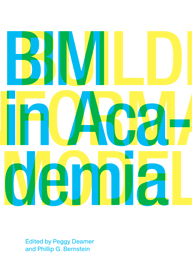
BIM in ACADemia

“The industry needs new specialists and if the academia doesn’t provide them, then the industry will have to resort to setting up private academies”. 
 – Practice 2006: Toolkit 2020 written by two Arup employees

BIM in Academia is a new collection of essays edited by the venerable team of Peggy Deamer and Phillip G. Bernstein.

The book is printed on demand by the Yale School of Architecture Press and therefore a bit hard to find.

So until it becomes more readily available, I’ll do my best to point out some of the more progressive and salient features of this important and much-needed document.

Generally, the 117 page book addresses whether

1. BIM ought to be taught in school, and if so,

2. How

The second in a series of these editor/educators’ books, after 2010’s excellent Building (in) the Future: recasting labor in architecture from Princeton Architectural Press – that I featured here a while back – the new book expresses several viewpoints without taking a strong stand.

The editors allow the faculty essayists to speak for themselves.

BIM in Academia, brought about by the Yale SOA Symposium in 2011, highlights some of the work taking place in US universities at this early moment in BIM’s evolution and argues, at best, that BIM must change the way architects work and are trained.

There’s a lot of great writing here. Of architects in the age of CAD, for example, the book says: “Their output was paper-based projections of the design rather than a simulation of the design wrought whole.”

Peggy Deamer’s opening essay “BIM in Academia” paints a picture of an already over-crowded curriculum which, now, we suddenly want to insert into yet another subject: BIM.

She asks:

  • Is learning BIM a software issue? (and therefore a non-credit workshop)
  • Should it be placed in the structures/technology course?
  • Is it part of professional practice?
  • Or is it a new way to practice design – and therefore be integrated into studio?
  • If this last is the case, should it be offered in the early, core studios – or be offered in an advanced or even post-degree studio?

Deamer emphatically fires the first shot by stating that BIM threatens all of the established hierarchies in academia and that no matter the designation – software, process or some combination – academia’s curriculum structure is unreceptive to BIM.

Next, Phil Bernstein’s serving-as-introductory essay, acknowledges the great divide between practice and education and offers a strategy – a model, really, based on the 40-year-old work of MIT’s Nicholas Negroponte – to re-examine the college curriculum under BIM.

Hereafter, the book is split into two parts: challenges and case studies.

There’s no effort to come to a comprehensive conclusion or to provide clear direction for the road ahead: the work is presented more or less as it was in the symposium.

We are left to come to our own conclusions. But let it be said that there is a lot of useful, helpful information offered here that – by the end of the book – ought to allow the reader to come to their own stance on the subject.

From the moment in the first paragraph that Renée Cheng’s essay, “Facing the Fact of BIM,” calls BIM a “maddeningly slow-to-learn design process,” any thoughts she’s going to gloss over the considerable difficulties of integrating BIM securely into the curriculum suddenly vanish.

Cheng has questioned the role of BIM in architectural education perhaps longer than any other educator or practitioner, so her perspective on past, present and future architecture curriculum is an important and valuable one.

After providing some much-needed background and context, Cheng admits that BIM is “excellent as a building production and project delivery tool” but disappointingly “a poor match with the needs of design students…”

Despite these handicaps, she writes, BIM emphatically has a place in the architectural curricula.

Where, exactly?

Her answer – in 2 hour professional practice courses – unfortunately leaves as many questions as it answers.

While the essays are generally of high quality, there are a couple clunkers – which is unfortunate, given how short a document this is.

“Characterizing the Problem: Bioenergetic Information Modeling” is largely unreadable – the three authors (chefs?) apparently didn’t get the memo that academic jargon belongs in subscription-only journals.

IIT’s “Master of Integrated Building Delivery” reads less like a case study than an advertisement for the program. Seeped in history and process, the text falls flat and fails to mention that the essay’s authors – John Durbrow and Donna Robertson – have either mysteriously left the program or are leaving this year (an oversight that is inexcusable given the book is printed on demand, in real time, and could have been pointed out or at least alluded to.) Full disclosure: I have guest taught, lectured and juried in the program.

Other essays – Andre Chaszar’s Beyond BIM come to mind – are considerably more helpful, after building their case provide specific recommendations for how to proceed.

As for the case studies – “Educating the Master Building Team” is a stand-out in the bunch – viewing BIM as a foundational technology to share information, and is a classic example of how thoughtful, engaging writing can and will help move the profession and industry forward. Excellent effort.

Auburn University’s Master of Design-Build (MDB) program’s case study – “Enabling Integration: the Role of BIM” – by Joshua Emig and Paul Holley extracts extremely useful observations and discussion points from their considerable studio experiment experience.

Points of view

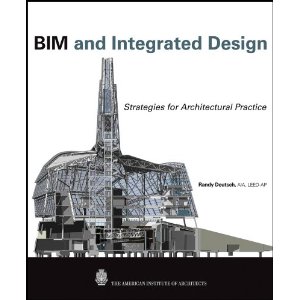
When I asked Phil Bernstein, in my book, BIM and Integrated Design, whether there was room for BIM in school, he said

“There’s a distinction, in my view, between training and teaching. At Yale, for example, you don’t get credit for learning a piece of software, any more than we would give you credit for using a band saw or a water jet cutter. Those are just skills that you pick up as part of the curriculum.” (pp.219-220)

Practitioners elsewhere have voiced their opinions on the subject.

Here is a sampling:

I do not believe that there should be special courses in BIM…BIM should be well integrated into the curriculum as simply what’s part of the professional workflow

At the community college where I teach part time…all the architectural drafting classes are being phased out and are being replaced by “BIM authoring for architects” classes

For industry to benefit from these studies, they must be conducted under Faculty (multidisciplinary) not School (single discipline) settings

More universities should just stop delaying the inevitable and start preparing ALL their AECO students for model-based collaboration and integrated workflows.

BIM programs abound

In Switzerland, at Berne University of Applied Sciences and Lucerne University of Applied Sciences, there are courses that focus on BIM including hands-on interdisciplinary BIM projects

Here is a comprehensive BIM class covering all aspects of BIM/VDC, from authoring to project management on a graduate level at USC School of Civil Engineering in conjunction with Virginia Tech: http://viterbi.usc.edu/news/news/2010/innovation-comes-to.htm.

Penn State has some BIM classes in their masters program.

Washington University in St Louis has also a few BIM courses in their architectural curriculum.

SOBE in UK has a post -grad course http://www.sobe.salford.ac.uk/courses/postgraduate-programmes/bim-and-integrated-design

And one of the best-known programs in CA is at Chico State http://cm.csuchico.edu/degree.html.

Additional reading and viewing

Until the book is more readily available, you might consider reading the following resources:

BIM in Academia: Collaborate, Adapt, Innovate by Alexandra Pollock, SOM New York. Download the White Paper (1.2 MB PDF) presented at Ecobuild America in 2010.

Integrating BIM with Academia: Pennsylvania State University from the 2010 BIM Award Program

Watch Yale University professor, Peggy Deamer, present on BIM‘s pedagogical placement in academia as she presented at the Autodesk Yale BIM Symposium.

The Role of Building Information Modeling (BIM) in Education and Practice abstract was presented by Laura Floyd and Douglas R Seidler at The Interior Design Educators Council 2010 Annual Conference – Atlanta, GA

Advancing BIM in Academia: Explorations in Curricular Integration http://www.igi-global.com/viewtitlesample.aspx?id=62944

And, as mentioned, I also have a chapter on BIM and education in my book, BIM and Integrated Design.

Leave a Comment

Filed under BIM conference, BIM instructor, education, process

An Integrated Design Strategy for Every Man, Woman and Child

“The concept of integrated design is key to a sustainable future and ultimately quality of life,” 
Laura Lee

Just as Finith Jernigan’s Makers of the Environment envisioned the average American benefitting from building information modeling (BIM),

Professor Laura Lee’s vision for South Australia reads like an integrated design strategy for every man, woman and child throughout the world.

While her publication was prepared as a series of recommendations to the South Australia government, upon reading it, it soon becomes clear that she had more universal applications in mind.

With her report, “An Integrated Design Strategy for South Australia – Building the Future,” Lee envisions a framework for uniting sustainability, behavior, materials and the external environment into a whole that satisfies the needs of people, environment and place.

I’ve read the report from beginning to end a couple times now and am happy to share my, however haphazard, impressions.

The excellent introduction acknowledges the potential – and urgency – of the state of the world today: the perfect set-up for what’s to come.

It answers why anyone would want to read this report – and, as importantly, why now.

Instead of just writing about design, the booklet (as a product) itself is a perfect argument for the value of good design.

Little touches – such as the global quotes in blue and local quotes in orange – and larger ones: that it is so well written, edited, illustrated and like all great works of art, all-of-a-piece.

Like the integrated design process itself, the report contains myriad voices (a strategy and conclusion I also came to for my own book on Integrated Design.)

From now on, all Integrated Design books really ought to be crowdsourced.

In fact, Lee had 15 partners (represented by 24 people) in the residency, only 4 of whom were designers, which if it was a challenge, doesn’t show.

The report leaves you with the impression that it was created by a singular sensibility in that it has one, compelling voice throughout.

Stevie Summer’s diagrams are intelligent and truly mesmerizing: the perfect accompaniment for the text.

The natural imagery of many of these diagrams – conch shells, DNA – are intertwined & interrelated with the book’s theme and text. Stunning.

Professor Lee invested so much time in the diagrams because she is interested in raising visual literacy.

Interestingly, it soon becomes apparent that the process in conceiving the report served as a model for those she worked with along the way for the integrated design process itself. What an effective way for those she worked with to ‘get’ integrated design.

One of the most appealing attributes of the report is that the overall tone and word choice is strangely non-academic. This is a report anyone could love.

Lee, for example, quotes Dan Pink where she could have quoted Roger Martin. In fact, the report verges on being populist were it not for the fact that the whole thing is so smart.

Because this does not read like research, one can see how it will be implemented (and not – like so many reports – sit on the shelf.)

By the time the reader gets to the end, they’ll recognize that the very tenets of integrated design went into the making of this brilliant and beautiful document.

The tone throughout is optimistic, forward-looking: exactly what it needs to be. No need to threaten readers with impending apocalypse (it doesn’t.)

Most reports and books fizzle out near the end – having spent all their ammo in the first half (if not the first chapter.) Here, some of the best, freshest information and diagrams occur in the recommendations section of the report, near the end, what Professor Lee calls “the heart and the future of the work.”

Many, many more people need to read this report.

Professor Lee is in the process of making an Integrated Design Strategy guidebook with roadmaps for each recommendation along with best practices, weblinks, and case studies and a website with PDF downloads that hopefully will be available soon.

Read the final report of Professor Laura Lee, Adelaide Thinker in Residence in 2009.

Read about Martin Seligman and other thinkers in residence http://www.thinkers.sa.gov.au/ including Prof. Laura Lee http://www.thinkers.sa.gov.au/thinkers/lee/

Read more about Laura Lee, FAIA http://www.thinkers.sa.gov.au/thinkers/lee/who.aspx

Check out these videos featuring Laura Lee, and also this and this video

And look into the integrated design work of other thinkers and makers, including Renée Cheng, Daniel Friedman, Frances Bronet, Ann Dyson, Billie Faircloth, Kiel Moe and many more.

Leave a Comment

Filed under craft, craftsmanship, education, Integrated Design, people, process, writing

This Week in Tweets

Here’s a smattering of the BIM and IPD-related tweets that my followers on Twitter have retweeted to their followers.

In addition to technology and collaboration, my tweets focus on creativity, architecture, design and construction.

Oh, and books, writing and poetry.

We’ll save those for another post. The following tweets are on BIM and IPD.

By browsing the list of micro-posts you will get a good idea of how I use it.

If you like what you see, please follow me on Twitter @randydeutsch

Collaborative #Learning for the Digital Age http://bit.ly/q7jsiH#SM#education

The End of the #Architecture Firm? http://lnkd.in/FR6th7#AEC#architects

Stewart Brand: “Once a new technology rolls over you, if you’re not part of the steamroller, you’re part of the road.” #BIM

Giving a talk about my #BIM book http://bit.ly/oHqJJ0 in #Chicago 9/12 at IIT Architecture | Master of Integrated Building Delivery

Lateral thinking and problem solving, perhaps. But #creativity is one lesson you ‘can’t teach’ http://bit.ly/qFUxBC

#BIM for Infrastructure http://bit.ly/o9I19I#construction#AEC#engineering

Building performance as brand http://bit.ly/qwaK1Q#performativity

Conference Addresses #Performativity of #Architectshttp://bit.ly/oMNrkQ#ACSA > SHoP Architects http://bit.ly/pOQl8v

Attend Integrated Project Delivery: A Catalyst for Collaborative #Design & #Constructionhttp://bit.ly/qdG9jl#IPD#architecture

Barriers to Successful #BIM by BIG BIM little bim author Finith Jernigan http://bit.ly/r1ctWH & http://amzn.to/ra2vTb > helpful checklist

MIT Unravels the Secrets Behind Collective Intelligence – HINT: IQ Not So Important http://www.singularityhub.com #collaboration

Enjoyed doing the panel yesterday with @newvoodou & @pwnakazawa at #SMPS2011 on “Trends: What to Look for When You Don’t Know What’s Coming”

If each GC firm wore their #BIM Score on a jersey, what would yours say? Where is your firm along the spectrum? http://bit.ly/pjP3le

 “Is Integrated Practice Taking Hold?” http://bit.ly/h7fpwL#IPD

 “People may accept or resist a technology not for what it does but for how it makes them feel.” Sherry Turkle in http://amzn.to/qML0XV

@threefourteen New in that it involves all stakeholders from earliest stages each of whom has input into what goes into making the decisions

@threefourteen Can get confusing…with integrative design, integrated buildings, integrated design process, integrated practice & IPD!

#BIM and Integrated Design: Strategies for Architectural Practice available pre-publication as an eBook http://bit.ly/pxOcxp#IPD

@Neil_BIM Great question. Due to length I had to cut the international BIM chapter but the remaining content is still applicable. Thanks.

Program Management Integrated with #BIM, demonstrating use of BIM-based PM tools via @jvandezande@HOKNetworkhttp://bit.ly/nZ31xp

Finding Your Way Around #BIMhttp://bit.ly/pqlKnb#IPD

Read Finith E. Jernigan’s book, Makers of the Environment, free http://bit.ly/rndf1q executive summary http://bit.ly/qbwA3Q

Design futures: Finith E. Jernigan’s blog, Makers of the Environment helps us look into the future http://bit.ly/reeZwM

Makers of the Environment is an information model whose foundation is a printed book. A book information model http://bit.ly/reeZwM#BIM

How seriously has recession damaged the construction industry? 65 markets suffer #construction declines of >75% http://bit.ly/rqCNMb

read the first chapter of my book free http://bit.ly/pIdOc1

#BIM & #IPD have a 8-in-10 chance of completing a project on schedule & within budget, an improvement fr previous stats http://bit.ly/pIdOc1

Let’s collaborate: AUGIWorld August 2011 #Collaboration issue is out! @AUGIhttp://bit.ly/fpjryJ http://www.augi.com/ #BIM#IPD

John Moebes, director of #construction at Crate & Barrel, will be a presenter at Integration Utah ACEO 9/20 http://bit.ly/mYO5xp#IPD

John Moebes highlights successes & challenges of #IPD. Crate & Barrel’s presentation on Integrated Project Delivery http://bit.ly/mYO5xp

Is IPD the right fit across the board? What It Means to #IPDhttp://bit.ly/nhv9qI#AEC#construction

As you start to integrate projects, remember Communication—Integration—Interoperability—Knowledge—Certainty drive #BIMhttp://amzn.to/qbFIxX

Tradition and legacy systems must not overshadow good business decisions. http://amzn.to/qbFIxX#BIM#CAD

You can only become expert in a limited range of issues. This makes #collaboration others a necessity not a luxury http://amzn.to/qbFIxX#IPD

Scripting Cultures: Architectural Design & Programming. Computer #programming integral to the digital #design process http://bit.ly/pHC30K

Mastering Autodesk Revit MEP 2012 from @WileyDesign – best tutorial & reference providing coverage of #BIM#MEPhttp://bit.ly/qBWS8i

Good discussion on whether #architecture school is the best place to learn #BIM and #IPDhttp://bit.ly/rkSZk3#AIATAP

One architect’s favorite iPad apps for #architects and #architecturehttp://bit.ly/odqWdT

@case_inc brought on board by Advanced Cast Stone to provide all LOD 400 #BIM#fabrication modeling > see the results http://bit.ly/hZmJ3y

Due to seismic shift, #BIM Migrates to Apple Platforms | Building #Design + #Constructionhttp://bit.ly/pIZoHg

eBIM™ Existing #BIM launches in UK > focuses on growing demand for accurate surveys of existing buildings http://bit.ly/o21h1i#AEC

What is #BIM about? Is it about software? Is it about technology? Is it about #Revit? > It’s about people @revit3dhttp://bit.ly/oK3Asy

Leave a Comment

Filed under BIM, collaboration, construction industry, education, Integrated Design, Integrated Project Delivery, IPD

10 Changes in Project Management due to BIM

I just returned from the excellent, inaugural two day Symposium on Technology for Design and Construction sponsored by Northwestern University’s Master of Project Management Program.

The 3 biggest differences between this Symposium and July’s BIMForum 2011 Chicago and June’s 2011 Revit Technology Conference?

The pace: Each speaker was given 30 minutes to present and field questions, which kept the topics and delivery sharp and on-target.

The mix: The attendees included Owners, Researchers, Academics, Practitioners, Developers, Vendors, IT Professionals and Students from Architecture, Engineering, Construction and Facilities Management.

The cost: The event is very affordable at just $200 for full registration and $25 for students.

Be sure to mark your August 2012 calendars for what will surely be an annual event.

If you would like to speak at – or co-sponsor – the Symposium on Technology for Design and Construction 2012 please contact Professor Raymond J. Krizek jrkrizek@northwestern.edu

Contractors kicked-off the first day of the conference, Thursday, August 18, 2011 with a series of talks focusing on Building Information Modeling.
1:00-1:30pm Kevin Bredeson – Pepper Construction and John Jurewicz – Lend Lease/MPM Faculty
1:30-2:00pm Kevin Labreque – Limbach

Kevin Labreque’s talk on eliminating waste in BIM deployment included this gem (from Dennis Sowards’ Lean Construction Practices presentation): the “8 Basic Types of Waste to Attack”

8 Types of Waste (Muda) to Attack

  • Defects in products: Rework, Field orders & Punch Lists
  • Overproduction: Fabricating material or ordering it too soon, JIC thinking
  • Inventory: Material stored at site or yard, work in process, unused tools & parts, forms and stashes
  • Unnecessary processing: Double & triple estimates from suppliers, redundant or unnecessary reporting, multi signatures on forms, material requisitions or time sheets, any non-value added steps
  • Unnecessary movement of people: Treasure hunts, looking for files, poor layout of work area (ergonomics)
  • Transport of goods: moving material, tools or parts, handing off work between crews
  • Waiting: Crews waiting for equipment, plans, RFI’s, field orders, or material, payroll waiting for time sheets, equipment waiting to fabricate material. Plus an eighth:
  • Unused employee creativity

Kevin nailed it when he said: “Technology is great – but behind these tools is a person and therefore, the integration of all these people.” Amen.
2:00-2:30pm Sandy Damasco – Lend Lease

Sandy stated emphatically: “The biggest issue isn’t the technology – it’s the adoption (of it.)”
3:00-3:30pm Stacy Scopano – Trimble

Stacy’s talk was remarkably informative, entertaining and poignant – all in one.

He acknowledged that other industries serve as a metaphor for our own and proceeded to use the example of Pac Man (us in 1980) and Gears of War III (kids today;) single-player vs. collaborative gaming; digital immigrants vs. digital natives.

Keep your eye out for Stacy Scopano and the work he’s doing at Trimble. One of our industry’s bright lights.
3:30-4:00pm Dan Klancnik – Walsh Construction
4:00-4:30pm Fred Cardenas – Meridian Systems
4:30-5:00pm Neil Parker – EcoDomus Inc.
5:00-7:00pm Reception

8:00-8:30am John Moebes – Crate & Barrel

As Director of Construction for Crate & Barrel, John Moebes kicked-off the Friday, August 19, 2011 talks focusing on Technology Management.

Moebes travels extensively presenting C&B’s dedication to and involvement with BIM, IPD, Design-Build, prefabrication and sustainability on their museum-like store projects.

I have seen him speak at least a dozen times and no two presentations have been quite the same. They have all been excellent and compelling arguments for the use of BIM and IPD to eliminate waste in design and construction.

Here are Moebes’ “10 Changes to Make to Management on Projects using BIM”

1. Establish what the BIM model will be used for

2. Have BIM standards at the very beginning

3. Push BIM and offer BIM

Crate & Barrel have become BIM evangelists. Your project team needs them too.

4. Get final BIM content as early as practical.

5. Use swim lanes and value-stream mapping

Crate & Barrel knows when to have their structural consultant and fabricator cross over the line to know where value can be gained. “The structural engineer needs to walk the fabricators line.” And vice versa.

6. Meet frequently but with results

Less “meetings” than (agile software development) huddles. “As the BIM gets larger you need to meet more frequently. Meet at least weekly or co-locate, if possible.”

7. Avoid re-modeling

“Know who models what. Assign  responsibility (to avoid redundancy.)”

8. Use a model umpire

9. Traditional 2D documents are very bad BIM

10. Get the BIM to the field and the field into the BIM


9:00-9:30am Jordan Brandt – Horizontal Systems

“For every BIM content creator there are 10-20 people who need that information.”

“It should be called conflict resolution, not clash detection.”
10:00-10:30am Andy Verone – Oracle
10:30-11:00am Steve Thomas – Lend Lease
11:00-12:00pm Paul M. Teicholz, research professor emeritus at Stanford University, co-founder of CIFE and co-author of the BIM
Handbook  (Wiley, 2011) has made revolutionary contributions to the construction industry through the use of information technology.

He and Atul Khanzode – DPR Construction – presented a case study on BIM and Lean in Construction via video conferencing.
1:00-4:00pm Healthcare Round Table

Be sure to visit the 2011 Symposium site for information on accessing all of the excellent presentations

1 Comment

Filed under BIM, BIM conference, Content Creation, education, IPD, modeling

BIM and Integrated Design – The Week in Tweets

Again, here are the BIM and IPD-related Tweets that my followers on Twitter have shared with their followers (retweeted or RT in Twitter parlance.)

Take a look. Click on the links to find articles, websites and other resources.

If you are not a Tweeter, by browsing the list of micro-posts you will get a good idea of how I use it. And if you like what you see, follow me on Twitter @randydeutsch

Enjoy!

@fedenegro @AddThis ‘BIM Implementation Guide’ is a great book – you can read my short review (and others) here http://amzn.to/m7M16o


Revit Roles: summary of the basic tasks in a #Revit environment from the perspective of a project manager http://bit.ly/l3OQ8P


Oldie but goodie. The Freshman: levels of #knowledge required of users to be successful making content for #Revithttp://bit.ly/jYZh8g#BIM


School’s out? New Course to Explore #BIM Contracts & Risk Allocation http://bit.ly/jM0GDs


BIM: Designing tomorrow http://bit.ly/mrTPLy#BIM


7 key ways BIM will affect you and your work: De-coding #BIMhttp://bit.ly/kZGOrA


Designing for Failure in the Cloud http://onforb.es/ix0QKI


Proof that #construction industry is reducing costs stemming from waste & adopting open-standard #BIMhttp://bit.ly/lAvueX #AEC #IPD


Building owners: Construction Owners Association of America addresses #BIM & #IPD from perspective of the owner http://www.coaa.org/ #AEC


He will be missed: Ralph Lerner, former Princeton #architecture school dean, dies at 61 http://bit.ly/m4DIrx #architects


Driving #Construction Project Success thru Neutral Trust Based #Collaborationhttp: //bit.ly/baJkzA & comments http://bit.ly/l1yhhg #BIM #IPD


22 people have “liked” my book ‘BIM and Integrated Design’ at http://amzn.to/kCKUuP & it doesn’t even come out for 3 months!


Interested in Making Your Company BIM-friendly? Check out AGC’s #BIM Education Program http://bit.ly/kyVQJ2 #AEC


Tech Trends: On-Site iPads Change the #AEC Game http://bit.ly/knm5Ym


Set them straight as soon as possible: Have the #BIM Truth Talk with Your Boss @Cadalyst_Maghttp://bit.ly/mlakae


Visit the Knowledge Lens: Northwestern U’s Center for Learning & Organizational Change, a community of practitioners http://bit.ly/bfXiPd


Improving Building Industry Results thru Integrated Project Delivery & Building Information Modeling http://bit.ly/mxOlcv #BIM #IPD #AEC


BIM Viewing Comes to the iPad – Portable #BIM now fully implemented http://bit.ly/lHZAEi #AEC #construction #architects #revit


@Opening_Design Have you seen this? via @fedenegro Basecamp for architects? http://ow.ly/52X0a #mergersandaquisitions #AEC


Top 10 List of “What BIM is NOT…” Vote today! via @caddguru http://bit.ly/ma7Jqt


Blog prediction: Autodesk will launch an integrated, multidisciplinary version of its #BIM solution: #Revit Integrated http://bit.ly/kugzGt


Webinar provides guidance to #construction counsel for evaluating whether & when to use AIA or ConsensusDOCs for #IPD http://bit.ly/mn7wLf


Integrated Project Delivery Invites Innovative Insurance Model http://bit.ly/lp0DIR > ‘invites’ but doesn’t innovate or solve #IPD


Polymath, Renaissance person, Multidisciplinarian (!) – Why we all must become one http://zd.net/kRoKem


Interview w Vinnie Mirchandani author of The New Polymath: Profiles in Compound-Technology #Innovations http://zd.net/91pytu


#Revit – Family Standards and Best Practices Version 2.0 (Kindle Edition) for creation of Revit family files http://amzn.to/kF0tZ4 #BIM


Check out the Northern California Virtual Design & Construction (NCVDC) website & blog – just launched http://ncvdc.org/ #BIM #IPD


Reserve yr spot! 5th Annual USC Symposium on Extreme #BIM: Parametrics & Customization. Friday, July 8 small f(r)ee http://bit.ly/lBCUsL


N Cal Virtual Design & Construction (NCVDC) meeting May 26, 2011 5:00 PM (PT) @perkinswill_SF http://bit.ly/lVqh0E #BIM #IPD #VDC #AEC


What do part-time & executive MBA programs have in common with Integrated Project Delivery? They’re both alternative delivery models! #IPD


Manhattan Real Estate Software did a nice write-up on my blog today (take that, Altos Research!) #BIM Grows Up http://bit.ly/kIPQDN


Fact: Half of all presentation proposals for CoreNet Fall 2011 Summit were on Building Information Modeling #BIMhttp://bit.ly/kIPQDN


FYI my rss feeds http://bimandintegrateddesign.com//rss.xml http://architects2zebras.com/rss.xml http://thedesignstrategist.com/rss.xml


To compete in a knowledge-based economy business leaders need to reinvent themselves as innovators in services http://bit.ly/ixxU24

Leave a Comment

Filed under BIM, BIM Director, BIM expert, BIM trainer, collaboration, construction industry, defining BIM, education, Integrated Design, Integrated Project Delivery, IPD, modeling, process

BIM and Integrated Design: The Week in Tweets

Here are some of my Tweets that had the most impact from May 16-22 2011, all 140 characters or less.

BIM and IPD-related Tweets that my followers on Twitter have shared with their followers (retweeted or RT in Twitter parlance.)

Take a look. If you are not a Tweeter, by browsing the list of micro-posts you will get a good idea of how I use it.

And if you like what you see, follow me on Twitter @randydeutsch

“We’re stuck in a mode where we’re using old systems of understanding learning to try to understand new forms.” ~ Douglas Thomas

Relating to people: #Construction sector gains soft skills w mentoring. Program helps workers w communication http://bit.ly/kODaWT#AEC

#BIM lawsuit: You read the headline? Now, read the +70 comments http://bit.ly/jRqH85 (Then, if necessary, read the article.)

Presentation recorded at the NYC Revit Users Group May 2011 Meeting: New Features in Revit 2012 http://vimeo.com/24012603#BIM

Finally, some good news for the hard-hit design profession: Firms are hiring again! Architecture Employment on the Rise http://bit.ly/lZ4caM

100% of UK government projects to use #BIM within five years http://bit.ly/lfzAk7

“America seems very rich but I never see anyone actually making anything.” from Making Things in America, PAUL KRUGMAN http://nyti.ms/mrka7v

You’ve heard it before: learning is a change you’re introducing into a work culture. #Learning Strategy Buy-In http://bit.ly/jpFLm8

Sustainable Performance Institute promises to deliver on the promise of sustainability http://www.sustainable-performance.org/#green

Looking Beyond the Structure: Critical Thinking for #Designers & #Architectshttp://amzn.to/iAkbEE

Computational Design Thinking: influential thinking on the formation of today’s computational #design discourse http://bit.ly/mLKtNq

Excellent review of AIA 2011 Convention: Thomas Friedman’s Keynote & Energy-Related Technologies @AECbyteshttp://bit.ly/m0Wp5m#AIA2011

“Building Industry Future Belongs to Contractors Who Know BIM.” Really? Not architects? http://bit.ly/kOsWWc#AIA2011

Learn how to protect your organization contractually from risks & legal challenges that come with #BIMhttp://bit.ly/l6Dcgm#revit#AEC

Is the Legal Risk of Building Information Modeling Real or Imagined? http://bit.ly/l6Dcgm#BIM

Daunting mountain to climb? Break it into molehills. Change Management and the Power of Small Wins http://bit.ly/jlEofm

The problem wasn’t #BIM, but poor communication. “Design team never discussed installation sequence w the contractor” http://bit.ly/ijYpiW

Description of Integrated Project Delivery course at California Polytechnic State University http://bit.ly/k10moh#IPD

34 days 18 hours 31 minutes 28 seconds 27 seconds 26 seconds…left until Revit Tech Conf 2011! http://bit.ly/cJGu7L#RTCUSA2011

3 reasons to attend Revit Tech Conf: 1. in California 2. spend 3 days w other Revit users 3. LOTS to learn http://bit.ly/cJGu7L#RTCUSA2011

The biggest challenge architects face today is making themselves relevant to owners.

Call for Presentations: submissions for the AIA 2012 National Convention in Washington, DC are due July 1

By adopting a process that considers collaboration, designers move from makers of things to design strategists http://bit.ly/jAG7dG

Ryan Schultz is the mastermind behind collaboration platform @Opening_Design. Check out his profile http://www.linkedin.com/in/ryanschultz

OpeningDesign.com is a community platform where #AEC professionals can collaborate with fellow building professionals. http://bit.ly/iXbciV

My book already ranked by Amazon Bestsellers Rank #669,047 in Books – and it doesn’t even come out until September http://amzn.to/kCKUuP

Click here to read the AUGIWorld May 2011 issue >>> http://bit.ly/fpjryJ#BIM#IPD#Lean#AEC

GREAT post by Case’s uber-BIM fanboy @davidfano Practice 2.0: “BIM is an opportunity, not a problem” @ArchDailyhttp://ow.ly/4WKKO

Owners didn’t ask for #BIM or for #IPD. They asked for less waste & adversity, more predictability & value. http://bit.ly/c4AHUq

Due to complications & risks associated with #IPD‘s multiparty contracts some are pushing integrated delivery (ID) http://bit.ly/iPPUSM

How to Reap the Benefits of #IPD w/o Pitfalls of a Multiparty Contract? http://bit.ly/kl4PWS & presentation http://bit.ly/k0ng2o

Launch event of the world’s first Masters program in BIM and Integrated Design on 7th June http://bit.ly/lBTnA9 & http://bit.ly/mfbl7G

Every Public Private Partnership project is by definition an Integrated Project Delivery project. Without #IPD#PPP would not exist.

Alternative Project Delivery Methods for Public Works Projects on difficulties of implementing #IPD in public sector http://bit.ly/mFnV4Q

2 Comments

Filed under BIM, BIM organizations, collaboration, construction industry, education, Integrated Design, Integrated Project Delivery, IPD, process

Building Knowledge in Architecture

Using books as floatation devices is nothing new.

Cradle to Cradle, subtitled Remaking the Way We Make Things, is printed on waterproof paper for this reason.

Poetry anthologies served this purpose after 9/11 as did commonplace books carried by soldiers.

In fact, the book I’m about to introduce you to defines the original use of the word “communication” to mean bringing something to the “common place, to the community, to make it part of the larger social group.”

That is what I hope to accomplish with this review.

Building Knowledge in Architecture is a new book and lifesaver by architect, educator, researcher, scholar and poet, Richard Foqué.

On the academic side, Foqué is a professor and dean emeritus at the Henry van de Velde Higher Institute of Architecture at the University College Antwerp.

On the practice side, Foqué is the founder and honorary principal of FDA Architects (now OSAR), one of the largest architectural firms in Flanders.

Richard Foqué’s work is characterized by the integration of architecture, art, design and science and reflected in the book “Bringing the World into Culture”, dedicated to Foqué and in which 21 eminent scholars, architects and designers bring a tribute to his work. An interdisciplinary thinker, Foqué lives and works in Antwerp, Belgium.

But don’t read Building Knowledge in Architecture because of his credentials.

Read this book because Richard Foqué is the first poet to write beautifully and meaningfully about the architect, design, creativity,

And as importantly, digital design tools such as BIM and collaborative work processes such as integrated design, design-build, lean construction and design thinking, subjects at the focus of these discussions.

You had me at Introduction

A book, like any of us, competes in a marketplace for attention.

Building Knowledge in Architecture, until today, appears to have been satisfied waiting patiently to be discovered on library shelves.

Book, wait no more.

To stand out and distinguish yourself, says consultant and author Sally Hogshead, you get only 9 seconds.

Because that’s how long our attention spans today have been shortened to.

Reader, here I’ll introduce you to what will surely become a fine traveling companion and fellow conversationalist in the weeks ahead.

But I’ll need 9 minutes to do so – not 9 seconds. So please bear with me.

Man Measuring the Clouds

A passing glance at a sculpture, Man Measuring the Clouds, inspired Foqué to reflect on architecture and what it means to be an architect today.

“The architect works in the field of tension between imagination and reality. The architect’s task is to convert the dreams and often unreachable wishes of the client into a buildable concept, which should be functional, technically resolved, and in compliance with all building and safety codes, but at the same time must inspire a sense of well-being and have the necessary aesthetic qualities to contribute to and enrich its context.”

Foqué then asks:

“Is the architect the person who is measuring the clouds all the time? Is architectural design, per se, an impossible task to perform? In other words, what is the essence of being an architect? What are the skills, competencies, and knowledge an architect needs to perform as a true professional?”

Aware of the access to practical knowledge readily available to other fields such as medicine, business and law, things can be otherwise for the architectural profession, the author sets out in search of a robust knowledge base architects can access:

“In my own practice, I have endeavored to use my professional experience and accumulated know-how in an innovative way for every new commission. But I have always been left with a feeling of discontent: Could I have done better? Did I use all the creative potential and knowledge at my disposal, and did I not overlook essential elements?”

Foqué concludes that the architectural profession no longer has a shared knowledge base. Building Knowledge in Architecture asks all of the important questions:

“Why did we abandon or sacrifice (this) knowledge base? Why is the architectural profession drifting? Why are we sometimes reinventing the obvious? Why do we struggle to cope with contemporary technological evolution, and why is it so difficult to integrate in a satisfactory way new findings and insights into our design solutions? Why are we losing ground, and why are essential responsibilities of our professional practice being assumed by others?”

One page into the book, you realize you have underlined every line. It is one of those books.

The Creation of New Knowledge through Practice

The book is organized in two parts.

In Part 1, Building Knowledge in Architecture serves as a practical overview of contemporary architectural design methods, and proposes design – apart from science and art – as a third way to investigate the real world.

“Perceiving themselves as practitioners of a ‘creative’ profession, architects hover between science and art.” p. 25

This is one of the very few books that discuss new digital design tools such as building information modeling (BIM) from academic, theoretical and practical standpoints (discussed for the first time on p. 93.)

But also integrated project delivery (IPD) or at least a facsimile of the same.

In the section called The Exteriorization of the Design Process, Foqué indicates that recent evolution of communication information technology processes forces designers

“…to interact increasingly with his environment. He has no escape, so to speak, but must engage in a permanent dialogue with his surrounding world.” p. 82

Foqué points out that the concept of transdisciplinarity – and the way specialized knowledge can be integrated – harkens back to the work of developmental child psychologist, Jean Piaget, in the 1970’s.

Where, according to the author, specialized knowledge needs to be incorporated into a comprehensive body of integrated knowledge, “within a global system of values and well-considered choices.”

Per Piaget, those who have taken part on integrated design teams will recognize the suggestion that multidisciplinary collaboration is, at root, child’s play.

Key quotes:

“Learning should be revalorized in the sense that the creators of knowledge should also be held accountable for the application of that knowledge.” P. 24

“It is recognized that at the modern university, there exists a hierarchy of knowledge, which starts with the basic and fundamental science at the top, applied science in the middle, and technical skills at the bottom.” P. 26

Explaining why digital design tools, while used extensively, are infrequently taught at the university.

“…grounded in the field of tension between ‘technical’ performance and ‘artistic’ creation. It is exactly in that field of tension that every professional discipline grounds its own knowledge base.” P. 26

Foqué defines a critical component of the architect’s arsenal, intuition, as “a not-yet-conceptualized and not-yet-systematized form of knowledge.” P. 27

Beautiful.

Before I go on to quote every line in the book, I want to point out an additional pleasure in reading a book written with a poet’s sensibility.

In describing the synergistic integration of art, science and technology, Foqué uses the seemingly simple example of learning to ride a bike.

“If you describe every part of a bike in extreme detail and add these descriptions together, you will by no means have produced an appropriate description of a bike.”

He concludes this explanation:

“In other words, it is not by knowing the why that you master the how. You need to add the artistic dimension, the art of bike-riding.”

As only a poet – who is also an architect, educator, scholar – could have written.

Foqué explains the now familiar story of how architects abandoned responsibility, and in doing so, relinquished authority, over the past 40 years.

He asks: How can we reverse this decline?

Part 2 of the book presents his case, so to speak.

Reinventing the Obvious

In Part 2, Building Knowledge in Architecture makes the case for case studies in architecture.

The case goes something like this:

Because case studies are used as teaching tools at law, medicine, and in MBA programs, architectural training should also include more reading and creating of case studies.

Here’s the problem with this argument:

It doesn’t need to be made.

In the introduction, the author asks: Why are we sometimes reinventing the obvious?

And then proceeds to fall into this same trap.

Architecture curriculums already make use of case studies. I know, for example, when I taught an integrated design/technology studio, we made great use of them.

They are not only, as the author argues, a practical tool for documenting complicated building projects, finding solutions to technical problems and expanding a firm’s expertise.

They are also excellent opportunities for having architecture students work in teams and learn how to collaborate on a project team while still in school.

The complexity of building projects almost guarantees that the teams will be multidisciplinary.

An example is Aaron Greven’s course in the College of Architecture at Illinois Institute of Technology (IIT) in the Integrated Building Delivery program, a class that focuses on integrated practices and the technology that facilitates collaboration across a broad range of building project participants, for the Masters in Integrated Building Delivery program, a post-professional program that is in its pilot phase.

While the example does not prove the rule, I have previously reviewed these case study presentations here.

And more recently, they have been reviewed here.

The book does an excellent job explaining case study research as a means to establish a knowledge base and, as importantly, develops a practical method to do so.

“Architecture is no longer considered a true discipline, based on a comprehensive knowledge base, as it was for more than 2000 years. It is clear that this situation is no longer tenable, if architecture wants to survive in the Information Age, and in a quickly changing globalized world. A key question regarding the discipline of architecture today is how we can build a store of knowledge again.” P.174

But for me, proving the case for use of case studies in architectural education is not the reason to read this book.

This point has been made before here and more importantly, here.

Perhaps it is not case studies that are needed but a knowledge management and information system that can readily access the design professional’s accumulated knowledge.

There are people out there who do just this.

But this book does provide the rationale as well as a unique approach to constructing case studies, grounded in the arguments and methodology presented in the first part of the book.

And more importantly, this book explains how we can build knowledge in our profession and industry through the use of case studies.

Eminently Tweetable

The strengths of the book overwhelm its few weaknesses.

Weaknesses first. For all of the wonderful discussion about design and creativity throughout the first part of the book, there is nary a general mention of or reference to either in the index. It is almost as though the index was created for academics who might scrutinize sources for perfunctorily academic reasons but alas, not for the general reader’s ease of use.

Likewise, many of the otherwise wonderfully rich sources cited, are from the 1970’s or earlier. The book would have benefitted the reader (but no doubt not fellow academics) by referencing more contemporary examples of the same ideas or even the cited author’s more recent work.

On the strength side, the book’s diagrams are truly spectacular and help to illustrate many of the book’s finer concepts.

Another remarkable and no doubt unintended strength of the book is it is eminently tweetable.

A book of well-composed sentences, Building Knowledge in Architecture is remarkably aphoristic, and there are literally hundreds of quotable 140 character lines that are just crying out to be tweeted on Twitter:

“Intuitive thinking and rational thinking are not opponents; they are the twin poles between which the artist structures reality.” http://amzn.to/lyhDEl

Foqué explains that in earlier craft societies, severe penalties were imposed on those members who reveal knowledge in public. P. 93

Today, we are rewarded for the same by being retweeted.

See below for how critical Twitter is to this discussion.

Read or drown

Read Building Knowledge in Architecture even if you don’t learn anything new by reading this book (you will.)

Because you will come to realize that by doing so, you will know what you know for the first time.

And that is some accomplishment. For any book.

It is absolutely critical that you read this book. Why?

Here are 3 reasons:

For all of the reasons I have stated above.

For the reason that it tells us where we have been, where we are today and where we are headed.

And for this reason:

When drowning and you are thrown a life preserver you don’t say, “no thanks, I’ve seen one of these before,” and toss your line to safety aside.

Do so and you’ll surely drown.

A strength of this author, as mentioned, is that he has one foot in academia and the other in practice, a perspective evident in nearly every sentence:

“Professional disciplines…reduce the gap between real world problems and academic research, research increasingly captured by its own agenda.” P. 25

A book such as this can go a long way starting to fill the gap between education and practice.

That the author is a published poet can be seen in the book’s nearly perfect prose – so clear that you will not need to go back and read any sentence twice.

But you will do so anyway.

Because the sentences are so well-written they’ll strike a chord in you.

And you will find yourself rereading them for the sheer wonder and pleasure.

So don’t read Building Knowledge in Architecture because it develops a general design theory, a theoretical framework and practical instrumentation to establish a knowledge base for the discipline of architecture.

Read it if you want to improve your understanding of the impact and motives on decision making so that your designs are more responsive to real needs.

Read Building Knowledge in Architecture because you are an architect, an educator or student.

Read it because books like this are why we still have books.

Read Building Knowledge in Architecture because we as a profession are adrift and this book has been thrown to us as a lifeline.

Read it because at a time when the publishing and construction industry are experiencing upheavals, it is heartening to discover a book that is as well-written and well-illustrated as it is well-constructed and physically beautiful.

The book feels good in the hand, like a book by Peter Zumthor.

When you hold it in your hand for the first time it will be as though you have done so before, as though the book is being returned to you after a long absence.

To you alone.

That is because this book has been written for you.

The book, Building Knowledge in Architecture, was recommended to me by Ryan Schultz, founder of http://www.openingdesign.com/ via Twitter

@randydeutsch Hi Randy, speaking of books… ran across this one today in the library… looks right up our alley: http://amzn.to/hX0YG2

@theoryshaw P. 78 of Building Knowledge in Architecture (Design as a rational Process: The Triangle Broken) could be your mission statement. Thanks!

Ryan, with fellow IPD maven Oscia Timschell, is launching a beta version of the new site in time for the AIA National Convention. Check it out and follow Ryan on Twitter @theoryshaw

FYI This blog was posted for readers at my other blog by a different name.

Leave a Comment

Filed under BIM, collaboration, construction industry, craft, design professionals, education, impact, Integrated Design, Integrated Project Delivery, IPD, modeling, people, process

How to Learn Revit in 1000 Difficult Lessons

In a time of drastic change, it is the learners who inherit the future. The learned find themselves equipped to live in a world that no longer exists. – Eric Hoffer

No matter where you fall on the BIM continuum, there is always more to learn, further you can take the tool and process.

You may know the program but can you, for example, get it to address the entire building lifecycle?

And there have never been so many ways to learn.

Books and , tutorials, webcasts, gurus, on-demand video, pilot projects, in-house and out-of-housetraining at local tech school or software reseller, regional training centers, bootcamp, side-by-side training and DIY.

Our friends Eddy Krygiel, Phil Read and James Vandezande are working on a Revit series for new users.

(I am so excited I get to write another spoof!)

Learn tips and tricks in forums such as AUGI forums.

You can order dvds and videos and learn at your own pace in pajamas.

Paul Aubin even has a Revit Architecture 2011 quick reference guide that doubles as a reusable dinner placemat for $4.95

It depends on what you are looking to learn.

And where you are on the BIM journey.

And whether you’re the office or in the field.

You alone know how you learn best and how you retain what you learn.

And that is key to learning.

So chose the method that is a good fit for you and your needs wherever you are on the learning curve.

There is no one size that fits all when it comes to training, retraining and retaining.

Take Revit (please)

You can actually learn it quite easily – several places offer ½ day, 1 day and 3 day training sessions.

Some offer cut prices for those out of work, both onsite and remote learning in the privacy of your home.

So why is learning so difficult?

The way we make learning anything difficult is by any one of  four reasons:

  • stopping and starting.
  • forgetting what you learned by not using it.
  • using a method that isn’t a good fit for your budget, lifestyle, mindset.
  • doing it for the wrong reasons,

such as being forced by your employer before you’re ready, through peer pressure, fear of not keeping up or being left behind.

There are those who will read the title of this post and either 1. feel justified in their having worked in ArchiCAD, a perhaps more intuitive BIM program or 2. empathize because they too struggled with learning the program and then struggled to keep up with the inevitable changes with each new release.

Take a deep breath

Before you pounce – this site is vendor agnostic.

Revit was merely used in the title to provoke and incite a riot – two requirements of any effective blog post headline.

So take a deep breath.

It is not that the lessons themselves are difficult.

Or even that the program application is difficult – though once you do learn to work in BIM you may find some advanced uses difficult to grasp.

The fact is, we each make learning difficult by not honoring the way we best learn.

And by ignoring other basic signs and practices.

Professional practice is hard enough – don’t also make the learning hard.

You owe it to yourself to make learning interesting.

Some training sessions meet from 8am to 5pm in a plain vanilla box of a room.

Not for you.

Can you sit still for that long, let alone learn a new application?

Ask yourself some basic questions

Ask yourself: What’s the best environment for you to learn in?

Doesn’t exist? (Then make it your pilot program and design it in Revit!)

Ask yourself: How important is it that your instructor be fun or at least interesting? Making the information and learning process interesting?

Make sure you are challenged – it is important that the instruction isn’t too easy (you’ll be bored) or too hard (you’ll feel defeated and give up.)

Look for a challenge worthy of your effort – one that will maintain your interest and engage you.

Get your hands dirty.

Work in the program as you go.

And be prepared. Have everything you need at hand before class begins.

Your instructor ought to be prepared as well – for students who are quicker or slower at picking-up the software – and be prepared to make adjustments accordingly.

Ask yourself: How do you know you’ve learned the program?

Having endured the tutorial many only mean you can produce what you were told to do in the tutorial.

Real projects have many more nuances.

The best way to know whether you’ve learned something?

Its very old school.

Take a test.

“To Really Learn, Quit Studying and Take a Test” found that students who read a passage, then took a test asking them to recall what they had read, retained about 50 percent more of the information a week later than students who used two other methods.

“One of those methods — repeatedly studying the material — is familiar to legions of students who cram before exams. The other — having students draw detailed diagrams documenting what they are learning — is prized by many teachers because it forces students to make connections among facts.”

But don’t take my word. Read the blog post and its over 320 comments.

Ask yourself: How do you know you’ve learned the program?

Teach it.

Those who are fortunate enough to attend training are sometimes asked to go back and teach those back in the office who did not, could not or would not attend training.

No better way to learn than teaching. If given this opportunity, jump at the chance.

Teaching BIM to others is a great opportunity to discover just how well you learned – and retained.

Turn off distractions including smart phones (you can leave this blog on.)

Kids might be able to study algebra while posting on Facebook.

You? Not so much.

In The Power of Mindful Learning, Professor Ellen Langer suggests that all of the all-nighters we pulled in college were for naught.

Why?

According to Langer, real learning takes place in a “mindful” environment, one that provides a context for the subject we are studying and allows us to bring something of ourselves into the process.

Make your training an extension of you.

Know what motivates and what de-motivates you.

Know why you are learning and have some sense about how far you want to take it.

Know who you are doing it for. As with anything you’re going to indulge time and effort in, you’ve got to own it.

Not only the tool but the process.


14 Comments

Filed under BIM, BIM expert, BIM instructor, BIM trainer, education, modeling, process

A Seeker’s Guide to BIM and Integrated Design

If BIM isn’t a spiritual practice why does it have so many dimensions? – Anonymous

The vast majority of design and construction professionals are happy to put in their time with the model and go home at the end of the day knowing they’ve contributed their share.

A small handful suspect there is something more to BIM than that.

This post is for them.

If you count yourself among the few – consider yourself a seeker.

Seekers recognize that BIM is not just technology, the next generation software.

For these select few, BIM is not an end in itself but a means to a higher end.

For seekers, BIM is a calling: an opportunity to tap into – and act on – their higher selves.

They may not be able to articulate what this something more is – they’re seekers after all.

Call their approach Zen and the Art of BIM Modeling or Modeling on the Contractor Within – titles admittedly as trite as they are timeless.

But they very well may be on to something.

Their approach to BIM is the subject of this post.

While I’m going to get a bit new-agey on you here

– seeing that this is a why-to not a how-to blog –

I won’t ask you to model crystals or bead curtains in ArchiCAD.

If the last time you were so incensed was when you got miffed at someone in the field,

And if you have no patience for pseudo-spirituality, sentimentality, proselytizing, fanaticism, holier-than-thou delusions and spiritual tourism,

Read on anyway.

A Better Way

This post is for those who are seeking a better way – to live, to work and to practice.

Let me start off by saying that the word “seeker” has a vaguely 60’s sound.

OK it has an overtly 60’s sound.

While it may seem like the only seekers these days are job seekers,

This is just not the case.

Meditate on this

I suspect if you’ve come here –and read this far – that you may be a seeker too.

Wherever you find yourself on the BIM path – considering it, adopting it, implementing it, mastering it, transcending it – you are on the right path.

While BIM has only been in the collective consciousness for a little more than a quarter century – the wisdom of working in BIM is ageless – having been passed down by master builders from generation to generation since the beginning of recorded construction.

Passed down today in the form of twin tablet computers each inscribed with Ten Commands.

Here, for the first time, are the 20 Commands every seeker ought to grok when working in BIM and Integrated Design.

Command I. Master BIM

For those more familiar with modeling programs and computer monitors than prayer books, BIM returns the user to a reverence for architecture and construction.

Whether you prefer your Testament Old or New, add a black silk tassel and you’ll find yourself on the critical path.

Whether you

»        haven’t tried BIM yet,

»        have been trained in BIM but aren’t using it,

»        are working in BIM but have not yet mastered it, or

»        have mastered BIM and are teaching it

start on page 1, and make it your goal to work your way through – tips, techniques and tutorials – from beginning to end until you have achieved Mastery.

Accept BIM. For whatever you accept, you go beyond.

Increase you personal and professional mastery by mastering BIM.

Command II. Honor your Inner Contractor

The days of freewheeling design – without a conscience, without acknowledgement of impacts to the environment, budget, schedule, material and labor availability and construction methods – are over.

Architects claim these were top-of-mind when putting pencil to paper and they may well have been.

But perhaps not so much when they were maneuvering a mouse.

Construction has become too complicated to keep everything in one’s head.

So work with checklists, and honor your inner contractor.

You’ll feel more complete.

And when contractors honor their inner architects we will all be as one.

Command III. Choose your Guide Wisely

When the student is ready the teacher appears.

Just as Google is our main map to the information highway, what is your map or guide to BIM?

Consider this guide, or a teacher, trainer, mentor or Sherpa.

Every pilgrim needs a map when first starting out, to chart a path in troubled times.

Make it personal – after learning the basics, learn your own way, and take your own path.

Plan your own journey into BIM and IPD.

Determine what works for you.

Just as America is a cross-pollination of religious, political, psychological, metaphysical, and ancient traditions that have flowered into contemporary life, you bring to your study of BIM and IPD years of schooling, work experience, indoctrination, beliefs, preferences and prejudices.

From these you will carve out your own path.

Create from this a contemporary, personalized approach to practicing BIM and Integrated Design.

Who will be your guide – your guiding light in these dark times? Who will help guide you on your charted or uncharted path?

Find a guide that sees themselves as a conduit to your professional education and fulfillment.

One that has your best interests and goals in mind.

To find a guide, look for signposts along the way.

Command IV. Let Go

Too many grasp – hold too tightly – to CAD, our old way of doing things.

Holding on to what came before. It is said,

A change here is a change everywhere.

So let go.

And let the program do the heavy lifting of coordination.

Freeing you to do what you do best.

The reason you went into this career in the first place.

It’s a scary proposition: BIM frees you to be what you were meant to be.

No excuses. No blame.

BIM is the end game.

You can think of working in BIM as dealing with loss – losing what came before.

But it is better to think of working in BIM from the perspective of a beginner.

To approach BIM with beginner’s mind.

For you cannot approach BIM with a CAD mindset.

There’s an art to starting over. It’s the art of letting go – of the old ways of doing things.

So let the new way in.

Relinquish the past and the future and work in BIM in the here and now.

Command V. The Best way to Learn BIM is to Teach BIM

You do not really understand something unless you can explain it to your grandmother. Einstein

Spending the past year writing a BIM book I have had to explain the concept to far too many grandmother types.

The best way to learn something is to teach it.

It is a priceless exercise to hone what you know by communicating it so simply and clearly that anyone could understand.

Even a seventh grader.

Most journalists are instructed to write so that a 7th grader could understand.

Could you explain what you do to a seventh grader so that they understand?

Volunteer at the local campus, sit in on crits, give a lunch and learn in your own office of that of a competitor, or help out those in the workplace by mentoring up or down.

But whatever you do – in order to learn BIM – you’ve got to teach it.

Command VI. Chop BIM, Carry IPD

Enlightenment can be found in the practice of BIM.

So practice BIM as though it were an art form.

But also practice BIM as you would do the dishes or brush your teeth.

Think of practicing BIM and working in IPD as nothing special.

Make BIM your practice and IPD your path.

Be present when working in BIM and mindful when working in IPD.

Bring awareness to every move you make in the model and at the table.

Command VII. BIM Marks a Return to the Shaping of Space

You were meant to be many things.

But perhaps most of all you were meant to be a shaper of space.

Working in BIM provides you – once more – with the opportunity to shape space.

We hear a lot about BIM objects.

The essence of BIM isn’t objects but emptiness.

BIM empowers you to work with all that is absent, what is not there.

Just as the air between the spokes forms the wheel.

Use BIM to give shape to the space between things.

Command VIII. Change the way you look at BIM and BIM itself will change

Use BIM to help you simply see things most people do not.

Look at BIM as just a tool – and that is what it will be for you.

Look at BIM as something more – a process, a path – and that is what it will be for you.

Your choice.

Don’t try to change BIM – it’s hard enough to get hold of someone at Autodesk – change the way you see it.

What’s easier? Changing you or changing Autodesk?

Change the way you look at things and the things you look at will change. Max Planck

Working in BIM and IPD should provide a peace that comes from seeing the world differently, more openly.

Command IX. BIM is not a Destination but a Journey

BIM is a tool as well as a process.

But what sort of process?

BIM is a process for reaching personal, professional and organizational goals.

A process for getting more work and becoming more profitable.

And a process for remaining relevant.

A process for working cooperatively with our teammates.

Make working in BIM your process, your journey, your path and you will prosper.

Command X. To Work in an Integrated Manner, Work from within – not without

BIM is an inside job.

Working in BIM will teach you that a building is not a rectangle with a roof and entry added any more than a bird is not an ellipse with head and tail added.

That’s SketchUp.

BIM is instead yet another form of your inner being, which you first have to identify yourself with in order to become a silent link of the creative flow.

In other words, you have to see yourself as integral to the design and construction of the model.

You do not stand apart from it.

Nor do you see yourself as separate or isolated.

It is not that you become one with the model.

That’s when you misidentify with what you are creating which can only lead to frustration.

Instead, become part of the process itself.

Not additive – though it may seem this way – but integrated.

You are working toward making a complete, whole work of art and architecture.

Not a building with things that can be blown off in a strong gust of value engineering.

With BIM everything is both connected and interconnected.

Command XI. The I in BIM is for Building

Enough has been written and said for now about the “I” in BIM.

BIM plain and simple is about the experience of Building.

Building, not destroying or tearing down.

Building, however virtually.

When you build in BIM you are building virtue-ly.

Not just with one’s eyes or hands alone, but with all of one’s senses, heart and spirit.

BIM allows you to put all of yourself into the model.

So put yourself into the model.

Don’t talk. Don’t draw. Build.

Command XII. BIM is the Path back to Purpose

We were doing ourselves a disservice.

We were designing irresponsibly.

We went into our chosen field – architecture, engineering or construction – for a reason.

So many of us have abandoned this reason.

Because it became more important to make rent or mortgage or associate.

Than to pursue our dreams.

BIM allows you to honor yourself. Your higher purpose. Your reason.

BIM gives you the opportunity to design and build honestly.

BIM and IPD together offer the chance to work honestly, with trust, with reward.

Command XIII. When you Work in BIM you Make Things Whole

There is a hidden wholeness in all you do.

You job is to discover it and uncover it.

Just as Michelangelo said every block of stone has a statue inside and it is the task of the sculptor to discover it, so too it is your role in BIM to discover the building inside.

As it is your role in BIM to discover the builder inside you.

We have for too long been incomplete, part architects.

Make it your goal to become whole again.

More complete architects as Winter Street Architect’s Paul Durand put it so aptly in BIM + Integrated Design (Wiley, 2011.)

Command XIV. BIM and Integrated Design’s Holistic Approach to Construction

Integrated Design is where a building is designed holistically using input from key stakeholders, including architects, contractors and owners.

A Whole Building Design approach involves immediate feedback from stakeholders on design decisions – an iterative process that draws from the wisdom of all involved throughout the life cycle of the project.

Resulting in greener projects, projects with less conflicts and needless cost expenditures.

Whole architect. Whole contractor. Whole building.

Command XV. BIM as a Discipline by which the World of Construction may be Rediscovered

BIM doesn’t teach you to draw, it teaches you to see.

Working in BIM helps you to learn to focus your attention while drawing, designing and constructing the model.

BIM teaches you that it is more important to be concerned with what you are observing than what you are putting down on paper or feeding into the monitor.

Observing the order of construction, layers of materials.

The steps taken in your seat are the steps taken in the field.

You understand why trades tripped all over each other at the jobsite,

Because you were doing so in the drawing.

You have a newfound appreciation for what comes after design.

Because you are at the jobsite when seated at your monitor.

On your bouncy ball.

Command XVI. Flow and Working in BIM

With BIM, there’s workflow. And, with BIM, there’s flow.

When so engrossed in what you are doing that time stands still?

Or disappears altogether?

That’s flow.

Get to the point where you are challenged by the work at hand.

But not so much so that you have to stop and ask questions every 20 seconds.

Aspire to ask questions every 30 seconds.

Then one every minute.

Doing so feeds the soul on a level akin to meditation.

And won’t aggravate your colleagues as much.

Work in BIM. Melt into the moment.

Command XVII. Approach BIM and IPD with Fearlessness

Look boldly at these tools and processes we have been given.

Here, now, on earth.

As a design professional or construction worker.

Everything changes…

Be bold.

Master the art of BIM to produce positive changes in our profession and industry.

Master the art of IPD to produce positive changes in our world.

This is not the time to be a wuss.

Command XVIII. Listen to your Body

BIM is intense work.

Taxing on the eyes, neck and wrists.

Long hours at your workstation, face in monitor – takes its toll.

Do not underestimate the wear and tear on your body.

Honor yourself. Play foosball. Take a prescription painkiller. Take a break.

Command XIX. “Live the Questionsrather thanSeek the Answers

A wise colleague estimated that when first starting out in BIM there will be one question every 20 seconds.

That can be taxing on you – and your more knowledgeable teammates.

Try this.

Come to them with solutions – suggestions – not questions.

Not how do I do x?

But when I tried x this happens WTF?

Not is there a better way?

But rather is this a better way?

Provide alternative solutions as you seek to understand.

Command XX. Create a Supportive Community

Join BIM groups on LinkedIn such as BIM Experts or AUGI.

Join BIM groups in your city or community.

But don’t just join – participate.

As with all things when you co-join you are helping to create community.

Meet with colleagues and peers after hours in your breakout room.

Make sure there’s plenty of Dos XX.

If for no other reason than to remind yourself:

You are not alone.

It is up to you to let everybody know:

We are all in this together.

14 Comments

Filed under BIM, BIM instructor, BIM trainer, construction industry, design professionals, education, Integrated Design, Integrated Project Delivery, IPD, modeling, people, process, workflow

Mastering the BIM Mindset

There’s one simple thing you can do for yourself today that will completely, radically and forever change the way you experience working in BIM. This post explains what that is.

Have you ever noticed some people are really excited about working in BIM?

While others dread it – or worse, are indifferent, neutral or less-than-enthralled?

This post explains why.

And better yet, will help you overcome the latter response.

People have 2 different settings.

According to Carol Dweck, author of Mindset, people are in one of two modes.

They’re either in the performing mode – where they’re expecting to perform.

Or else they’re in the learning mode – where they’re expecting to grow.

Growth types

Mindset has a simple premise:

The world is divided between people who are open to learning and those who are closed to it, and this trait affects everything from your worldview to your interpersonal relationships.

Those who work in the performing mode see themselves as fixed – I know what I know and every day I come to work to prove what I know.

They’re primarily concerned about looking good.

Those in the growth or learning mode work in BIM expecting to grow, change or learn from their experience.

They’re Always-Adding-to-their-Toolbox-types (2A4Ts or 2A40s.) We all know them.

We might be a 2A40 type ourselves.

Fixed types

Others believe their intelligence is capped. Fixed.

There’s a limit – its set – their mind’s set. Mindset.

They won’t be the ones taking themselves – or BIM – to the next level.

Not by choice anyway.

But rather kicking and screaming.

They’re happy treating BIM as the next generation CAD.

Stuck in this-is- just-the-next-software mode.

Do not pass go.

Do not cross the chasm to 4D, 5D or D’yond.

These two modes – performing and learning – may go a long way to explain how motivated you will be to work in BIM.

Without a growth mindset, there’s no mastery.

As posted in these pages, Mastering Autodesk Revit Architecture 2011 comes out this month. (I can’t wait!)

And yet there is no mastery without the growth mindset.

You have to be able to imagine yourself improving, growing and changing – in order to master a skill.

Otherwise you’re fixed. Like a dog.

Which one are you?

Are you here to show us what you can do?

Or do you arrive in the morning to discover something new?

Here’s a test:

When you come home at night does your partner/roommate/spouse ask you how did you do today?

Or what did you learn today?

And which of the two do you ask yourself?

Judge & Perform or Learn & Grow

I don’t divide the world into the weak and the strong, or the successes and the failures… I divide the world into the learners and non-learners. – Benjamin Barber

People with a growth mindset constantly monitor what’s going on.

They’re attuned to its implications for learning and constructive action.

They’re constantly on the inquiry, asking:

What can I learn from this? How can I improve? How can I help my teammate do this better?

One Simple Thing

There’s one simple thing you can do today that will make all the difference in the world.

That will vastly change your life and the experience you have – your satisfaction and fulfillment – at work.

It’s not enough to say change your attitude when the program is driving you bananas.

It’s not helpful for someone to tell you to change your mindset when no one has ever bothered to explain what one of those are or how you might go about doing that.

The one thing is free.

And best of all it is easy and painless.

This is it.

You ready?

What we need to do while working out the kinks in BIM and plowing through the barriers, roadblocks and obstructions that naturally arise in the program is this:

Change your internal monologue from a judging one to a growth-oriented one.

That’s it.

So stop beating yourself up over changes to the user interface, families from manufacturer’s content and working with nested groups.

And approach BIM as a learning tool.

When you go to work – while performing your duties – you’ll be secretly attending the University of BIM.

Practice acting on the growth mindset.

And ask yourself this:

  • Will you allow yourself to be in the BIM mindset where you approach working in BIM in terms of learning and professional growth?
  • Will your employer enable you to work in a learning mode without negative repercussions or feeling that you are being judged and evaluated?
  • Is it realistic, in this economy, to expect anything but 100% performance from our workforce – that learning on the job, when it happens, is a bonus but not a necessity?
  • Will we work all the harder and more effectively if we feel that we are learning and growing on the job?

5 Comments

Filed under BIM, education, impact